
A Consequential Week Concludes

- A week that saw a controversial FOMC meeting followed by first-tier economic releases finally comes to an end. First, the FOMC meeting concluded with an almost identical statement as the June meeting and coming after a pickup in Middle East hostilities and increased oil prices, that surprised most investors. It’s no secret that Fed Chair Kevin Warsh wants the Fed to talk less, but repeating what was stated six weeks ago doesn’t apparently suffice and the market voted accordingly. We had mentioned before that the lack of communication would lead to more uncertainty and volatility and we got both in spades this week. Away from the Fed, we received the first look at second quarter GDP and the Fed’s preferred inflation measure, PCE, for both the second quarter and June month-end. We explore those results below and get ready for next week’s bevy of July reports concluding with the employment release on Friday. Currently, the 10yr is yielding 4.68% up 2bp, while the 2yr is yielding 4.27%, up 4bp on the day.
- The first estimate of second quarter GDP underwhelmed with a headline print of 1.5% annualized vs. 2.0% expected and 2.1% first quarter. However, the always important consumer consumption results were strong and that should be the key takeaway from yesterday’s report. The headline was dragged lower by downward moves in inventories, government spending, and trade as a slowdown in export sales shifted the net trade contribution to GDP more negative as import levels held their ground with first quarter totals.
- Meanwhile, personal consumption increased 3.2% vs. 2.3% expected and 0.5% first quarter. Thus, consumer and business investment (think AI data center buildout) saved the quarter from being worse given the downward adjustments mentioned above. The metric that focuses on private domestic demand, Real Final Sales to Private Domestic Purchasers, (consumer spending plus business investment) rose 3.9% from 1.7% in the first quarter, illustrating the solid showing from two key players in the economy (see graph below).
- On the inflation front, the GDP deflator surged 6.2% annualized vs. 3.6% prior as higher energy prices early in the quarter weighed on results. Core PCE (ex-food and energy) rose but at a more reasonable rate of 3.4% annualized which was a tenth under the 3.5% expectation and down from 4.4% first quarter. The Personal Income and Spending report was also released yesterday and has more details for the month of June which we’ll explore next.
- Core PCE for June rose 0.1% vs. 0.2% expected and nicely down from 0.3% in May. YoY core PCE rose 3.3%, matching expectations, and a tenth lower than the 3.4% in May. Overall PCE declined -0.1%, matching expectations, as lower oil prices contributed to the drop with the YoY rate cooling from 4.1% in May to 3.7%. The core PCE rate, while lower than expectations, was higher than core CPI (0.0% MoM, 2.8% YoY), and that will be something the Fed’s recently convened data measurement task force will no doubt be looking at.
- Another positive from the June PCE data was the improvement in the so-called super core PCE which is essentially services ex-food, energy, and housing and had been a trouble spot of late. For June, super core was up 0.12% MoM vs. 0.52% prior with the YoY pace slowing to 3.81% from 3.89% in May. As the graph below shows, monthly improvement has been uneven so a string of similar prints to June need to occur to keep potential rate hikes limited.
- While PCE inflation news was better in June vs. May the uptick in oil prices in July will limit that improvement. How that transpires in July and August before the September FOMC meeting will go a long way in settling the “will they hike?” question for that meeting. Right now, odds are around 65% they will hike.
- There’s no rest for the weary as next week brings a boatload of July reports, headlined by the employment report on Friday, August 7. Expectations are for payrolls to grow by 93 thousand vs. 57 thousand in June with the unemployment rate up a tenth to 4.3%.
Second Quarter GDP Dips as Trade, Inventories, and Gov’t Spending Weigh on Results 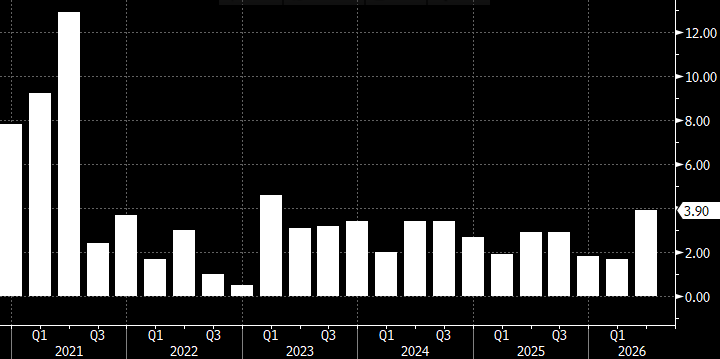 Source: BEA
However, Personal & Business Spending (Real Final Sales to Priv. Domestic Purchasers) Were StrongSource: BEA
June PCE and Core PCE Improved Slightly From May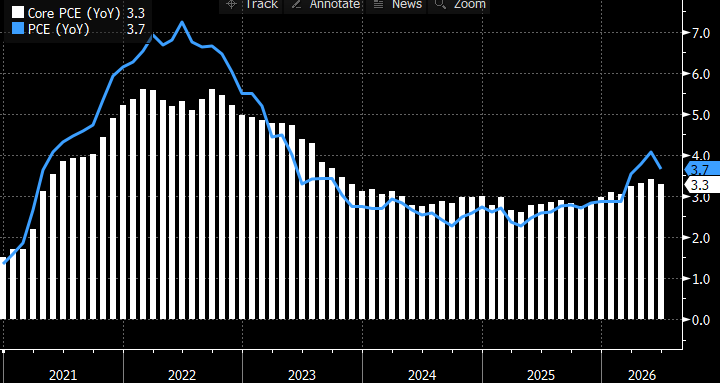 Source: BEA
Core Services Ex-Housing (Supercore) – Nice Move Lower in June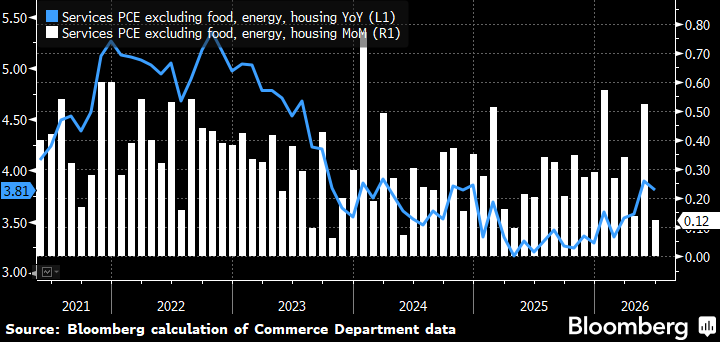 Source: BEA
Securities offered through the SouthState | DuncanWilliams 1) are not FDIC insured, 2) not guaranteed by any bank, and 3) may lose value including a possible loss of principal invested. SouthState | DuncanWilliams does not provide legal or tax advice. Recipients should consult with their own legal or tax professionals prior to making any decision with a legal or tax consequence. The information contained in the summary was obtained from various sources that SouthState | DuncanWilliams believes to be reliable, but we do not guarantee its accuracy or completeness. The information contained in the summary speaks only to the dates shown and is subject to change with notice. This summary is for informational purposes only and is not intended to provide a recommendation with respect to any security. In addition, this summary does not take into account the financial position or investment objectives of any specific investor. This is not an offer to sell or buy any securities product, nor should it be construed as investment advice or investment recommendations.


