
A Credibility Question

- The administration’s fiscal and monetary policies were subject to close inspection this week, and it could be the beginning of a new phase in financial markets. First, the US Treasury surprised markets on Wednesday announcing increased buybacks of longer duration bonds to arrest the increase in market yields, or better yet, encourage them lower. Then, the FOMC minutes from the July meeting arrived which provided more insight into the Fed’s pause decision which Fed Chair Warsh wouldn’t, or couldn’t, explain fully in his post-meeting press conference. Bessent followed Treasury’s Wednesday announcement with a Thursday interview where he explained a new focus on “fiscal consolidation” will be forthcoming. With these scattershot actions, questions have arisen over the administration’s fiscal and monetary policies. We discuss those issues in more detail below. Finally, following Wal-Mart’s disappointing quarterly earnings, concerns increased over the state of the consumer, especially after the weak retail sales report from last week and that contributed to selling in equities. Based on futures, however, an early bounce is expected. We’ll see if it holds. Currently, the 10yr is yielding 4.69% unchanged on the day, while the 2yr is yielding 4.19%, also unchanged on the day.
- The market was surprised Wednesday morning when the Treasury announced it would increase the size of buybacks of longer duration bonds to enhance market liquidity, and more importantly lower market yields. The plan is to increase the size of purchases in the 10-20yr maturity spectrum and 20-30yr range from $2 billion to $4 billion, respectively, beginning September 9th. That had the effect of lowering yields around 10bps. By Thursday, however, yields were headed higher once again as the limited scope of the buybacks became apparent, and the overarching issues that catalyzed the move higher remained in place.
- In a CNBC interview yesterday, Bessent said he’s prepared to expand efforts to buy back debt and that the administration will be unveiling a new fiscal initiative to address the highest yields in years. “We are announcing probably at the end of this week, beginning of next week, an increased focus on fiscal consolidation,” Bessent said. He explained that the expanded buyback announcement on Wednesday was intended to ensure orderly trading in a “thin” summer market, and to get investors to focus on “fundamentals.” That may be so, but financial markets are looking for results and not more task forces to study problems. With $40 trillion in public debt, deficits adding another $2 trillion annually, and current market yields above 4% vs. a 3.4% weighted average cost of outstanding Treasury debt, the fiscal problem is going to get worse before it gets better, and that is something quite fundamental.
- While the Treasury was busy with its announcements, the Fed was busy as well. With the Warsh Fed limiting views of a reaction function as to monetary policy, and/or forward guidance, we are left with the minutes in trying to fill holes left by an opaque communications strategy. Fortunately, the minutes provided the information on why the Fed held rates steady in July. In the minutes, we learned:
-
- Most members believed inflation would step down over the rest of the year as the inflationary effects of energy supply disruptions and tariffs wane. The soft inflation data in June supported that thesis, but it was a singular data point and not decisive.
- When the labor market was mentioned, it was felt to be in balance, with unemployment near its longer-run level, so there was no urgency from that mandate and that was clear from the limited mention of it in the minutes.
- Members also noted that little had changed in their assessments since the June meeting only six weeks earlier. Holding rates in July allowed the Fed to gather more information before its September meeting.
- The Committee saw inflation risks as skewed to the upside, and many members favored raising rates if inflation does not decline. Several were already in favor of a hike in July, including the three dissenters.
- The Committee’s stated reason for holding was that information arriving before September “could provide more clarity” about the inflation outlook.
- That last point refers to the still outstanding July PCE inflation report (due next Wednesday), and August CPI and jobs reports. Keep in mind too that the softish July CPI and weak jobs report came after this meeting as well. So, while Warsh downplayed the cool June CPI report during the post-meeting press conference, it was a key piece of the discussion with the Committee and they left the meeting seeking more confirmation of softening prices and given that the labor market appeared stable (in their words), there was no urgency to act in July.
- Initial Jobless Claims declined to 206k in the week of August 15 vs. 210k expected and 212k prior (revised from 209k). This brings the four-week moving average up to 204.00k from 199.75k, a four-week high. Continuing Claims rose to a six-week high 1.799mm for the week ending August 8 vs. 1.788mm expected and 1.781mm prior (revised from 1777k). Roughly speaking, a steady-as-she-goes report on the labor market, but the uptick in the four-week moving averages for both initial and continuing claims does warrant a little attention and something to watch in coming weeks. The initial claims week coincides with survey week for the upcoming August jobs report, so it carries a little more importance.
Futures Still See Low Odds of a September Rate Hike 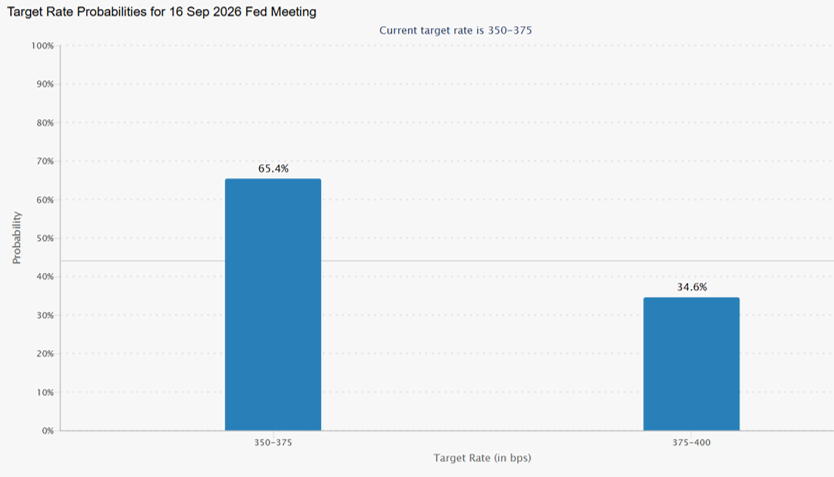 Source: CME Group
30yr Bond Yield Approaches 20Yr High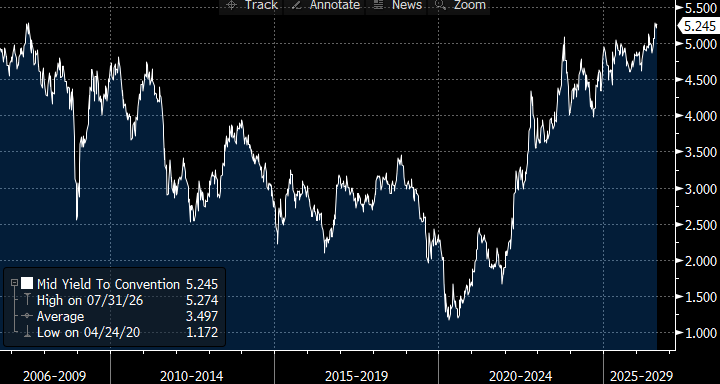
Source: Bloomberg
Meanwhile, Oil, Gas, and Diesel are Headed Higher Again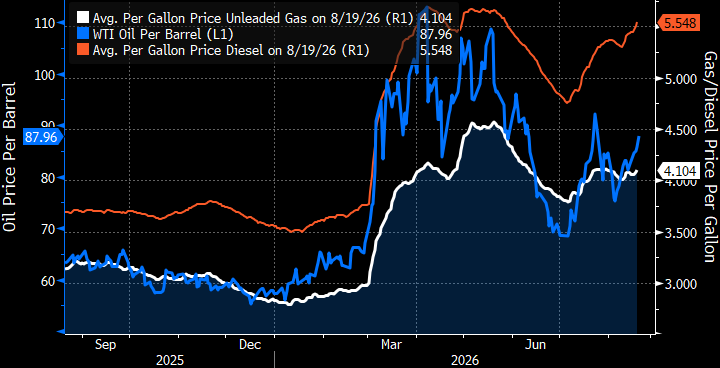 Source: Bloomberg
Securities offered through the SouthState | DuncanWilliams 1) are not FDIC insured, 2) not guaranteed by any bank, and 3) may lose value including a possible loss of principal invested. SouthState | DuncanWilliams does not provide legal or tax advice. Recipients should consult with their own legal or tax professionals prior to making any decision with a legal or tax consequence. The information contained in the summary was obtained from various sources that SouthState | DuncanWilliams believes to be reliable, but we do not guarantee its accuracy or completeness. The information contained in the summary speaks only to the dates shown and is subject to change with notice. This summary is for informational purposes only and is not intended to provide a recommendation with respect to any security. In addition, this summary does not take into account the financial position or investment objectives of any specific investor. This is not an offer to sell or buy any securities product, nor should it be construed as investment advice or investment recommendations.


