ADP Job Gains for June Solid but Miss Expectations

- June data is starting to arrive, and it looks like a decent if unspectacular month of economic activity. This week’s reports focus on the labor market with today’s ADP Employment Change Report and the ISM Manufacturing Index and its employment measure. Also, the JOLTS report from yesterday provided the first look at the labor market but remember it’s May data so a bit dated but still helpful in assessing labor market equilibrium. We also have some Fed speak to round out the offerings with new Fed Chair Kevin Warsh taking part in an ECB forum this morning. We’ll see if he continues with the less is more communication framework he advanced in last month’s debut as Fed Chair. Currently, the 10yr is yielding 4.50% up 8bps on the day, while the 2yr is yielding 4.19%, up 5bps on the day.
- The first of several labor market reports for June was released this morning with the ADP Employment Change Report missing expectations with 98 thousand new private sector jobs vs. 120 thousand expected and 122 thousand in May. Recall, May was the largest monthly gain since January 2025, and June was expected to approach that but fell short. Tomorrow’s BLS payrolls report is expecting 110 thousand private sector jobs and 113 thousand overall.
- As usual, job gains were strongest in healthcare at 48 thousand while manufacturing, which halted a 26-month losing streak in April, added another 5 thousand jobs in June. Trade/transportation at 15 thousand and financial activities at 14 thousand were the other sectors with notable gains. Leisure and Hospitality at only 2 thousand new jobs was one of the disappointing sectors. Annual wage growth for Job Stayers was 4.4%, matching the May gain, while annual wage growth for Job Leavers was 6.6% vs. 6.5% in May. Annual wage gains have been trending lower since peaking at 8% (job stayers) and 16% (job leavers) in 2022. Over the past year, however, wage gains have been fairly stable with a slight deceleration noted. For example, a year ago, annual wage gains for job stayers were 4.5% and for job leavers 7.0%.
- Yesterday, another labor-related report but for May, the Job Opening and Labor Turnover Survey (JOLTS) reported job openings remained at the highest level in almost two years, adding evidence of that labor market resilience continued as AI data center building and ongoing strength in healthcare propelled openings. Available positions were unchanged at 7.59 million, easily beating the 7.30 million expected. The Layoff Rate (layoffs to total employed), however, increased from 1.0% (adjusted down from 1.1%) to 1.1%, partially reversing the two-tenths decline in April. It touched a low of 1.0% in January and November in the past year and indicates, despite the slight one-tenth increase, that the low-fire environment continued in May.
- The Quits Rate (voluntary separations to total employed) remained at 1.9% for the second straight month after dipping from 2.0% in April. That matches the low set in February and last October and November and is the lowest rate since 2020. A year ago, it was 2.1%. The rate is a measure of worker confidence in finding better/higher paying employment (i.e., a higher rate indicates more confidence in finding better work), so the stable rate indicates that the slight reduction in confidence from April is not worsening. For now, the story remains one of weaker labor force growth, but growth, nonetheless.
- Meanwhile, the June Conference Board Consumer Confidence Index inched up by 0.6 points to 91.2 from a downwardly revised 90.6 in May. The original May sentiment was 93.1, so a significant revision and June’s print missed the 94.5 expectation. The Present Situation Index—based on consumers’ assessment of current business and labor market conditions—fell by 3.0 points to 116.4. The Expectations Index—based on consumers’ short-term outlook for income, business, and labor market conditions—rose by 3.0 points to 74.4. The survey period for this month’s preliminary results was June 1–23, encompassing an extension of the US-Iran ceasefire agreement. However, perceptions of the current labor market softened as the percentage of consumers saying jobs were ‘hard to get’ rose to 22.5%, the highest level since January 2021 (22.8%). Moreover, consumers anticipate little change in the labor market six months from now.
- Consumers’ average and median 12-month inflation expectations were less elevated in June, reflecting in part the tentative peace agreement with Iran and the lower oil/gas prices starting to be felt in June. From May’s 6.2%, the average inflation expectation was 6.0% for the next 12 months, while the median level dipped from 5.3% to 5.0%.
- At 10am ET, the ISM Manufacturing Index will be released with expectations for the headline to tick lower from May’s 54.0 to 53.9. If expectations are met, the largest segment of the economy continued in solid expansionary territory for June. The Prices Paid Index will get inflation scrutiny with the index expected to decrease from 82.1 to 77.5. If that comes to pass, it will be an improvement from May but still the second highest prices paid reading since August 2022 and another indication that inflation pressures will continue. New Orders are expected to slip slightly from May’s 56.8 to 55.0, and the Employment Index is expected to improve slightly from 48.6 to 49.0 but still below the 50 expansion/contraction dividing line, but certainly an improvement from March’s 45.2, the lowest since December 2023. Thus, the manufacturing sector appears to be firmly in expansion territory, aided by firms purchasing ahead to beat further price increases, but ongoing price pressures remain evident.
June ADP Reports 98 Thousand New Private Sector Jobs vs. 120 Thousand Expected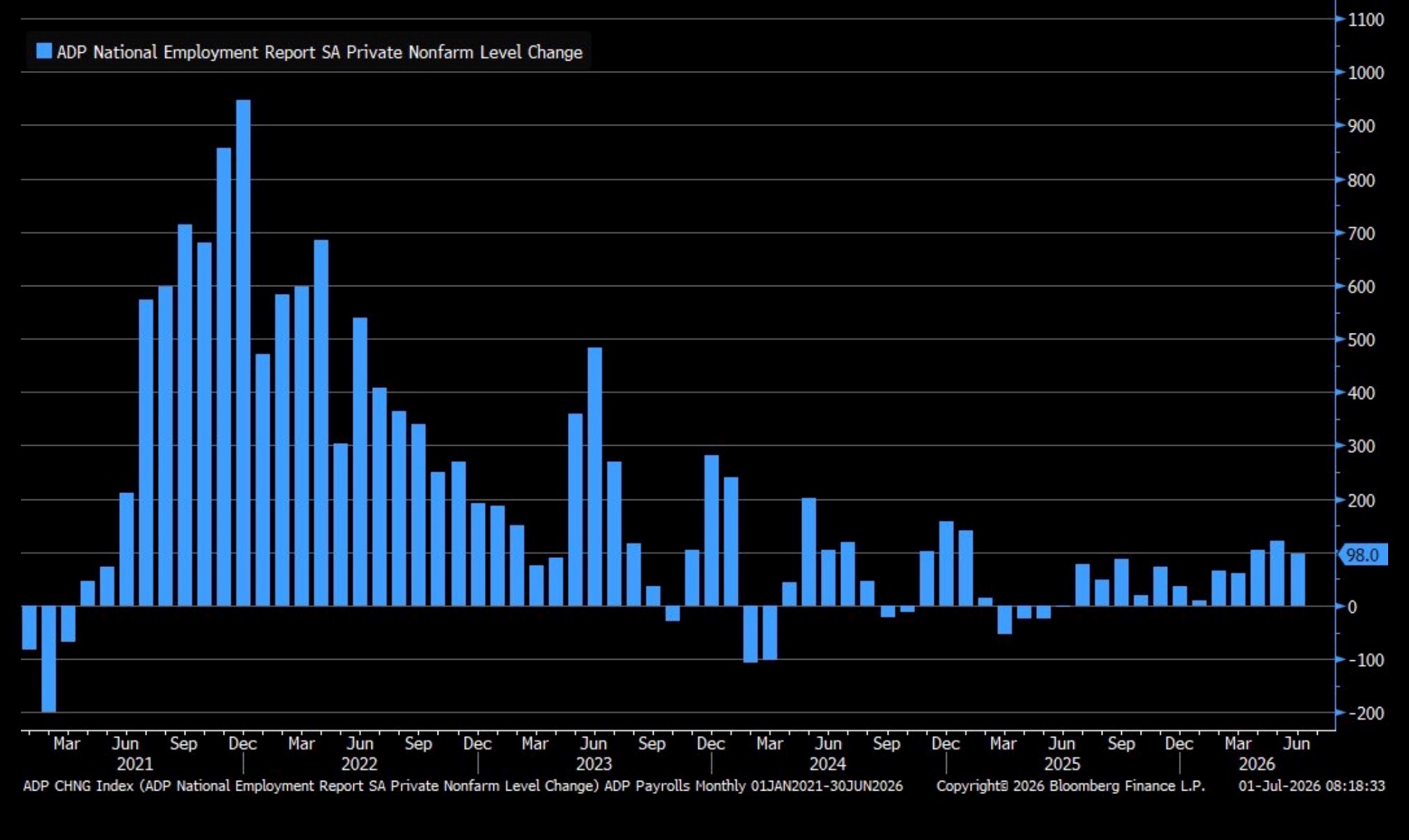 Source: ADP
May JOLTS – Job Openings Unchanged after April’s Pop Higher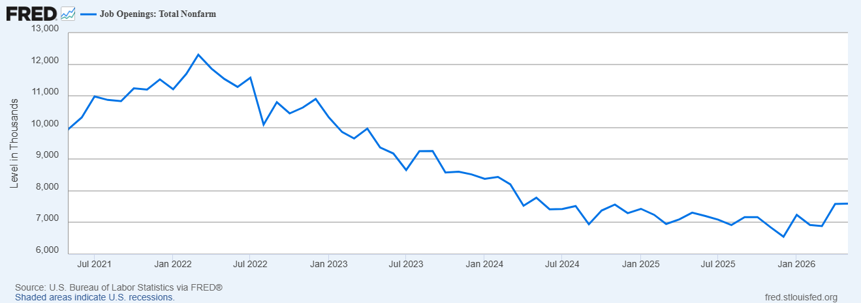 Source: BLS
June Consumer Confidence Improves Slightly from May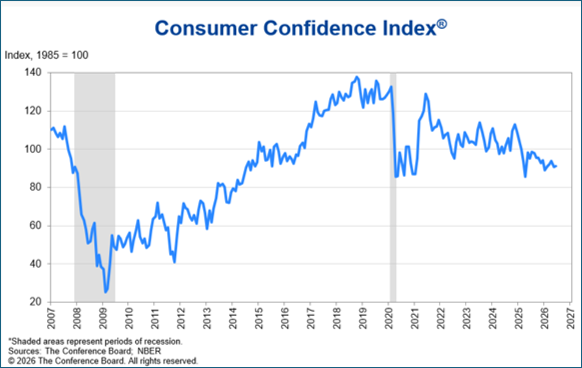 Source: Conf. Board
June Inflation Expectations Remain Elevated but Improved Slightly from May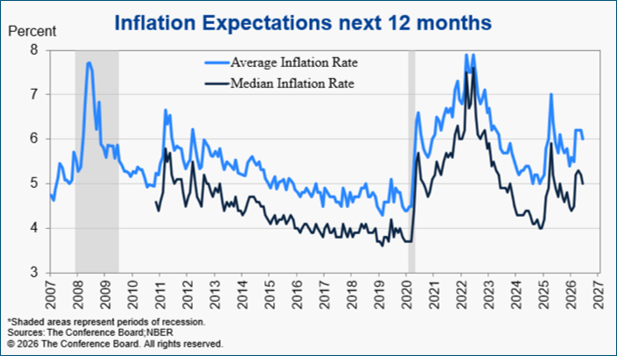
Securities offered through the SouthState | DuncanWilliams 1) are not FDIC insured, 2) not guaranteed by any bank, and 3) may lose value including a possible loss of principal invested. SouthState | DuncanWilliams does not provide legal or tax advice. Recipients should consult with their own legal or tax professionals prior to making any decision with a legal or tax consequence. The information contained in the summary was obtained from various sources that SouthState | DuncanWilliams believes to be reliable, but we do not guarantee its accuracy or completeness. The information contained in the summary speaks only to the dates shown and is subject to change with notice. This summary is for informational purposes only and is not intended to provide a recommendation with respect to any security. In addition, this summary does not take into account the financial position or investment objectives of any specific investor. This is not an offer to sell or buy any securities product, nor should it be construed as investment advice or investment recommendations.


