
After Weak Jobs Report, Inflation Numbers Await

- There will be no rest for the weary, and after a weak July jobs report attention quickly shifts to the Fed’s other mandate, inflation. The soft July employment numbers complicate the Fed’s job as the focus has been squarely on corralling inflation. Investors’ concerns were immediate after the jobs report, with odds of a September rate hike sinking from 60% to 46% (see graph below). While the weak jobs numbers will continue to be sifted through, July inflation numbers arrive on Wednesday with the latest CPI report. PPI follows on Thursday and on Friday the Retail Sales report will provide a look at July consumption. After the soft wage gains in the jobs report, one question must be whether the consumer has enough firepower to continue their consistent consumption. Expectations are for a decent month of sales, but a tad below June, which was a tad below May. Currently, the 10yr is yielding 4.67% up 1bp, while the 2yr is yielding 4.22%, up 2bps on the day.
- On Wednesday, July CPI will shift the discussion away from jobs and back on inflation. Expectations are for headline inflation to increase 0.2% MoM with the YoY headline unchanged at 3.5%. Recall in June, headline CPI was off -0.4% as energy prices fell with the Iran MOU in place. That changed in July and energy prices reversed about half of the June gains.
- Core CPI (ex-food and energy) is expected to increase 0.3% MoM vs. 0.0% in June with the core YoY rate down a tenth to 2.5%. The problem is that the next two months, August and September, see 0.2% rates from last year rolling off the YoY rate, so it will be difficult to see much improvement by the September FOMC meeting if we’re adding new 0.2% or 0.3% monthly increases. Thus, it looks like the hawks will still be fighting for a rate hike in September, but now with the added concern of a potentially weakening labor market to complicate the decision.
- The inflation numbers continue Thursday with the July PPI Report. Expectations are for overall wholesale inflation to be up 0.2% after falling -0.3% in June. PPI ex-food and energy is expected to increase 0.3% vs. 0.2% in June. PPI ex-food, energy, and trade is also expected to increase 0.3% vs. 0.1% the prior month. So, given the modest move higher in July energy prices, the wholesale price universe looks a bit hotter than it did in June, and even ex-energy expectations are for a hotter July vs. June. If that comes to pass, it’s likely just a matter of a month or two before the wholesale price increases rolls down to the retail level. Once we have CPI and PPI this week, analysts will start calculating estimates for PCE (the Fed’s current preferred measure of inflation) which will be released at month-end.
- July Retail Sales on Friday provide a brief pause in inflation numbers with sales expected to increase 0.3% vs. 0.2% in June. Ex autos and gas, monthly sales are expected to increase 0.3% vs. 0.4% the prior month. The Control Group – a direct feed into GDP and considered a better core look at spending is also expected to increase 0.3% vs. a solid 0.5% in June. The caveat we always offer for this report is that it’s not inflation adjusted so be careful with reading nominal increases especially in this period of heightened and volatile price pressure. In any event, with that warning, sales are expected to be decent but not up to the June results, which were solid but less than May’s results. Notice a trend?
- Finally, the preliminary University of Michigan Sentiment Survey for August will be released on Friday. Recall that in July, overall sentiment improved to 55.2 but expectations are for a slight retracement to 54.0 in August. As the Fed wants inflation expectations “well anchored,” year-ahead inflation expectations will be a key reading with July’s at 4.2%, down from 4.6% in June. With the uptick in oil prices in July, it’s not likely that much improvement will be found in the update. For example, back in February, before the Iran war, the year ahead inflation expectation was 3.4%, and 2025 readings were in the 2.3-3.0%. Long-run (5-10yrs) inflation expectations were unchanged in July at 3.3%. In 2024, values ranged between 2.8% and 3.2%, while in 2019-2020, they were consistently below 2.8%. So, inflation expectations are not likely to build on July’s brief improvement. They will remain above pre-war levels and pre-pandemic expectations. That will be noted by the FOMC Inflation Hawks.
Fed Funds Futures for a September Rate Hike were 60% before Payrolls, now at 46%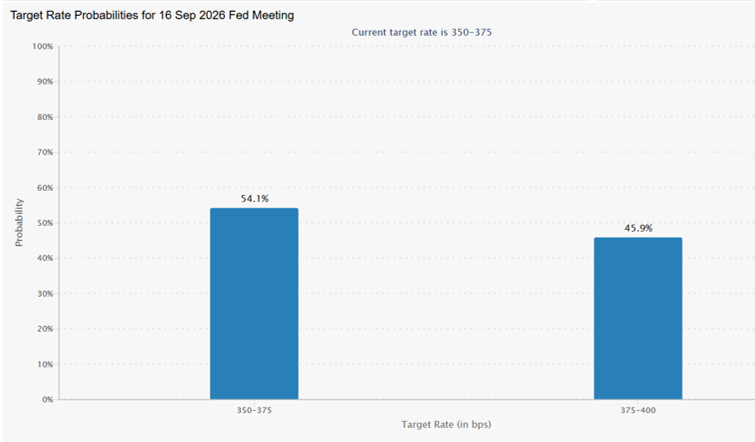 Source CME Group
July CPI Due Wednesday – Expectations are for Overall at 3.5% (Unch) and Core at 2.5% YoY (-0.1%)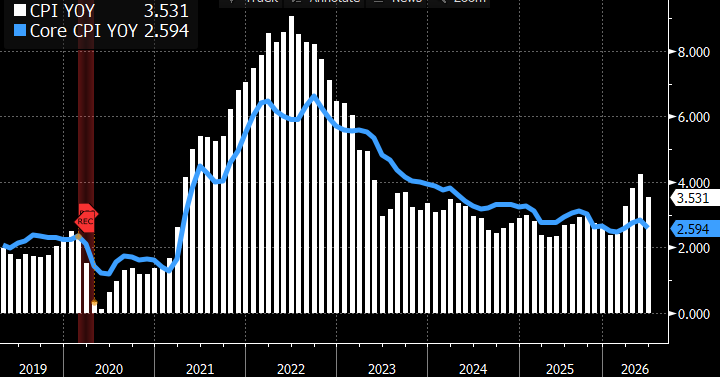 Source: BLS
Univ. of Michigan Sentiment Poll – Consumer Much More Concerned over Gas Prices vs. AI Influence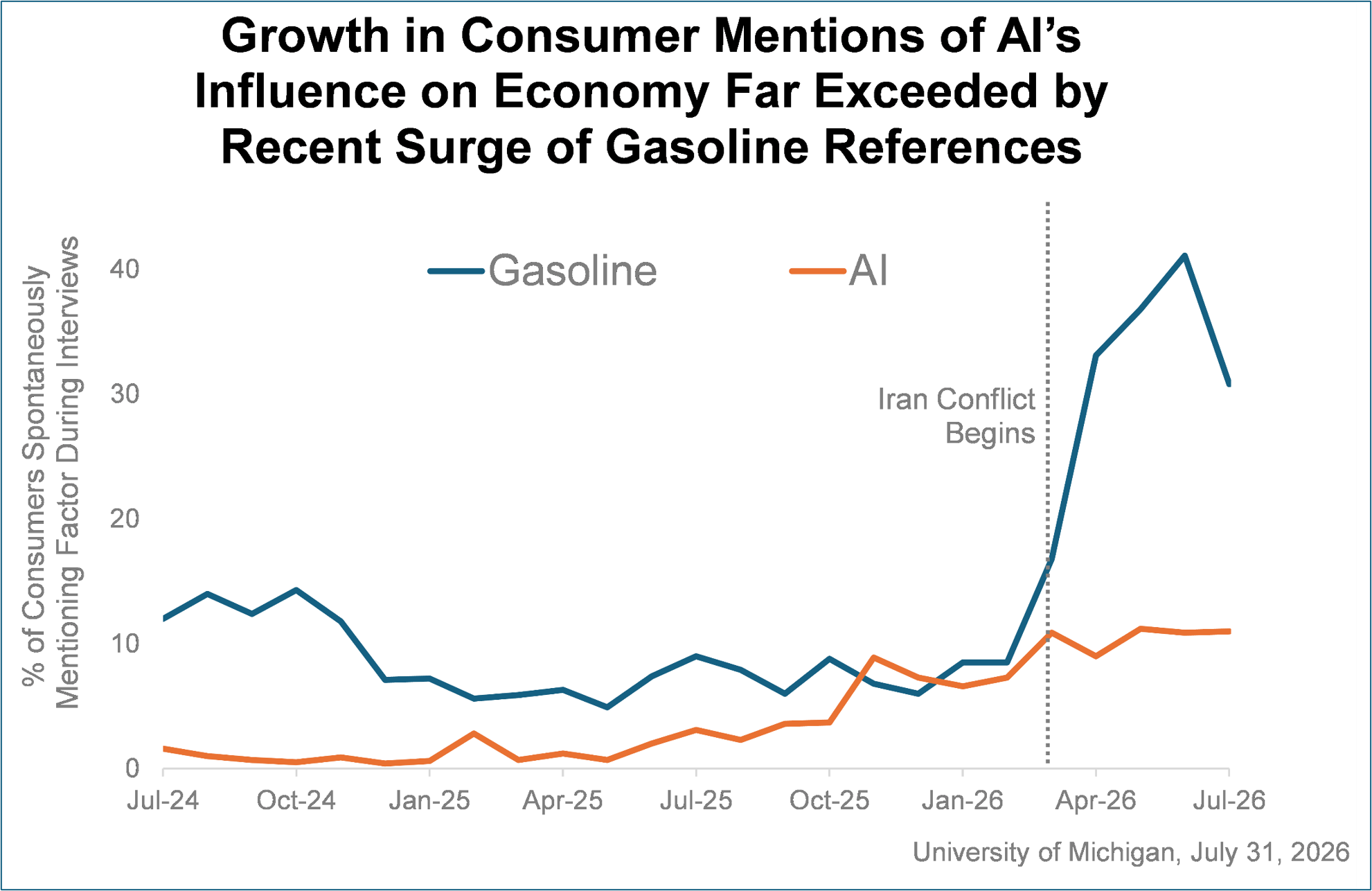
Source: Univ. of Michigan
Securities offered through the SouthState | DuncanWilliams 1) are not FDIC insured, 2) not guaranteed by any bank, and 3) may lose value including a possible loss of principal invested. SouthState | DuncanWilliams does not provide legal or tax advice. Recipients should consult with their own legal or tax professionals prior to making any decision with a legal or tax consequence. The information contained in the summary was obtained from various sources that SouthState | DuncanWilliams believes to be reliable, but we do not guarantee its accuracy or completeness. The information contained in the summary speaks only to the dates shown and is subject to change with notice. This summary is for informational purposes only and is not intended to provide a recommendation with respect to any security. In addition, this summary does not take into account the financial position or investment objectives of any specific investor. This is not an offer to sell or buy any securities product, nor should it be construed as investment advice or investment recommendations.


