
AI Buildout Dominates Third Quarter GDP

- The first estimate of third quarter GDP was released yesterday, and the 3.4% QoQ annualized result exceeded the 3.2% expectation and 2.2% second quarter print. The fingerprints of AI were all over the results which we’ll detail below. Also yesterday, the Personal Income and Spending report, which was a part of 3Q GDP, gave us September results. More on that below. Finally, the FOMC held rates unchanged on Wednesday which was expected but many Fed watchers came away unhappy as the self-described inflation fighter Kevin Warsh failed to adequately explain why the Fed decided to pass on a rate hike when September inflation numbers were universally warmer than expected. Then, a strong 3Q GDP, fueled by AI spending and consumer consumption, painted the picture of an economy running full steam ahead seemingly unconcerned with higher interest rates. In any event, we set our sights on next week’s mid-terms which will provide plenty of political tape bombs in addition to the typical first week-of-the-month data deluge, headlined by the October jobs report. Currently, the 10yr is yielding 4.91%, down 8bp, while the 2yr is yielding 4.57%, down 9bp on the day.
- The U.S. economy grew at a 3.4% annualized rate in the third quarter, accelerating from 2.2% in the second quarter and beating the 3.0% expectation. The fingerprints of the AI buildout were all over this report as nonresidential fixed investment rose 12.7%, with information-processing equipment—computers, servers, and related hardware—surging 37.4%, while software investment rose 9.6% and R&D 7.5%. The Bureau of Economic Analysis, which produces the GDP results, specifically identified computers and peripheral equipment as the leading contributor to equipment investment.
- Consumer spending was also strong at 3.8%, so this wasn’t solely an AI story. Underlying private domestic demand (Real Final Sales to Private Domestic Purchasers) rose an impressive 4.9% vs. 4.6% in the second quarter. One caveat is that a substantial amount of AI hardware is imported, so the surge in capital-goods imports subtracts from GDP and we noted that in the most recent goods trade deficit numbers that had a large import of computer related equipment from China and Taiwan. Overall, the GDP report portrays an economy with surprisingly strong domestic demand, with the AI capital-spending cycle now clearly one of its major growth drivers. That demand story makes the Fed’s decision to pause on Wednesday even more curious as supply shocks don’t necessarily correct via rate hikes, but as a tool to soften demand they are quite effective.
- Yesterday’s Personal Income and Spending report was a part of third quarter GDP results, but it provides a view of September’s results and the handoff to the fourth quarter. The report showed consumers continued to spend, although the increased spending was due to higher prices. Personal income rose just 0.2%, while consumer spending increased 0.5%; however, because the PCE price index also rose 0.5%, real consumer spending (spending adjusted for inflation) was essentially unchanged, and real disposable income actually fell 0.3%.
- The inflation numbers were the bigger concern: headline PCE accelerated 0.5% month-over-month and rose 3.6% year-over-year from 3.4%, while the Fed’s closely watched core PCE rose 0.3% for the month and 3.1% year-over-year, up from 3.0% in August. Households also appear to be leaning more heavily on savings to support spending, with the saving rate falling to 3.8%. Overall, the report points to a consumer who is still spending but losing purchasing-power momentum, alongside inflation that remains above the Fed’s 2% target.
- Next week brings the usual first-week-of-the-month data deluge of first-tier October results headlined by the October jobs report, due on Friday. Expectations are for a modest 55 thousand new jobs with the unemployment rate unchanged at 4.2%. Average hourly earnings are expected to rebound from a meager 0.1% monthly gain in September to 0.3% in October. Despite that expected earnings uptick, the yearly income gain is expected to fall from 3.0% to 2.9%. In conjunction with the declining savings rate the dip in annual wage gains will fuel concern over the health of the consumer and the ability to keep spending at their recent clip.
- Next week also brings the midterm elections on Tuesday and whether a “Blue Wave” arrives will be the first takeaway. Complete results probably won’t be known for several days but expect the political tape bombs to add to the normal first-of-the-month catalysts. It will no doubt make for an eventful and interesting week. Stay tuned!
Odds at 73% for December Rate Hike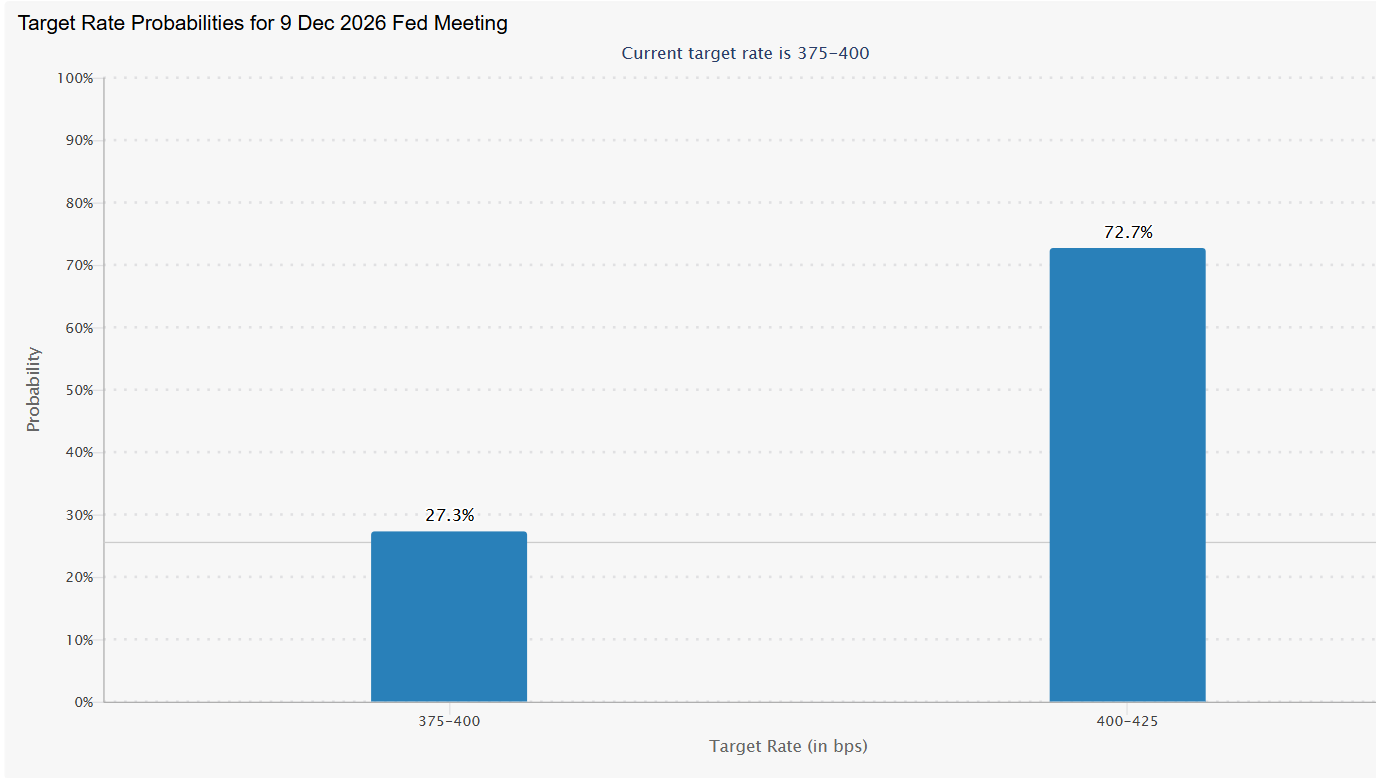 Source: CME Group
3Q GDP Improves from 2.2% to 3.4% as AI Spending Increased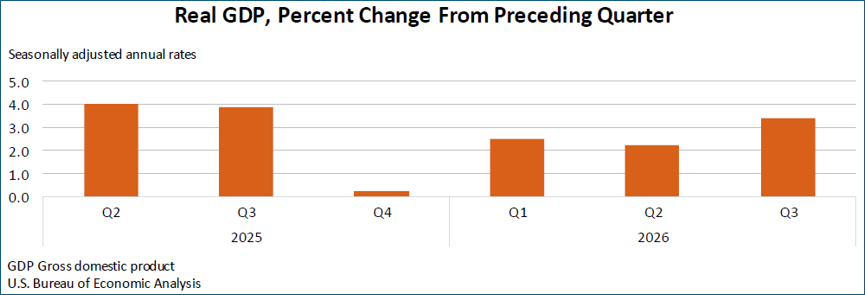 Source: US Bureau of Economic Analysis
AI and Consumer Spending Drove 3Q GDP 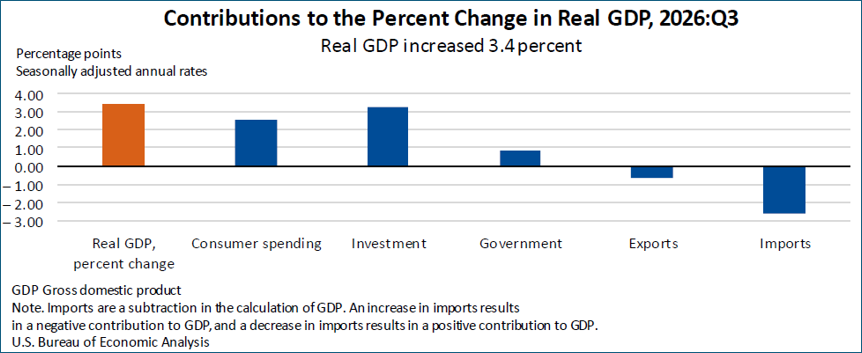 GainsSource: US Bureau of Economic Analysis
YoY Core PCE Ticked Higher in September as Core Services ex-Housing Increased as Energy Spike Spreads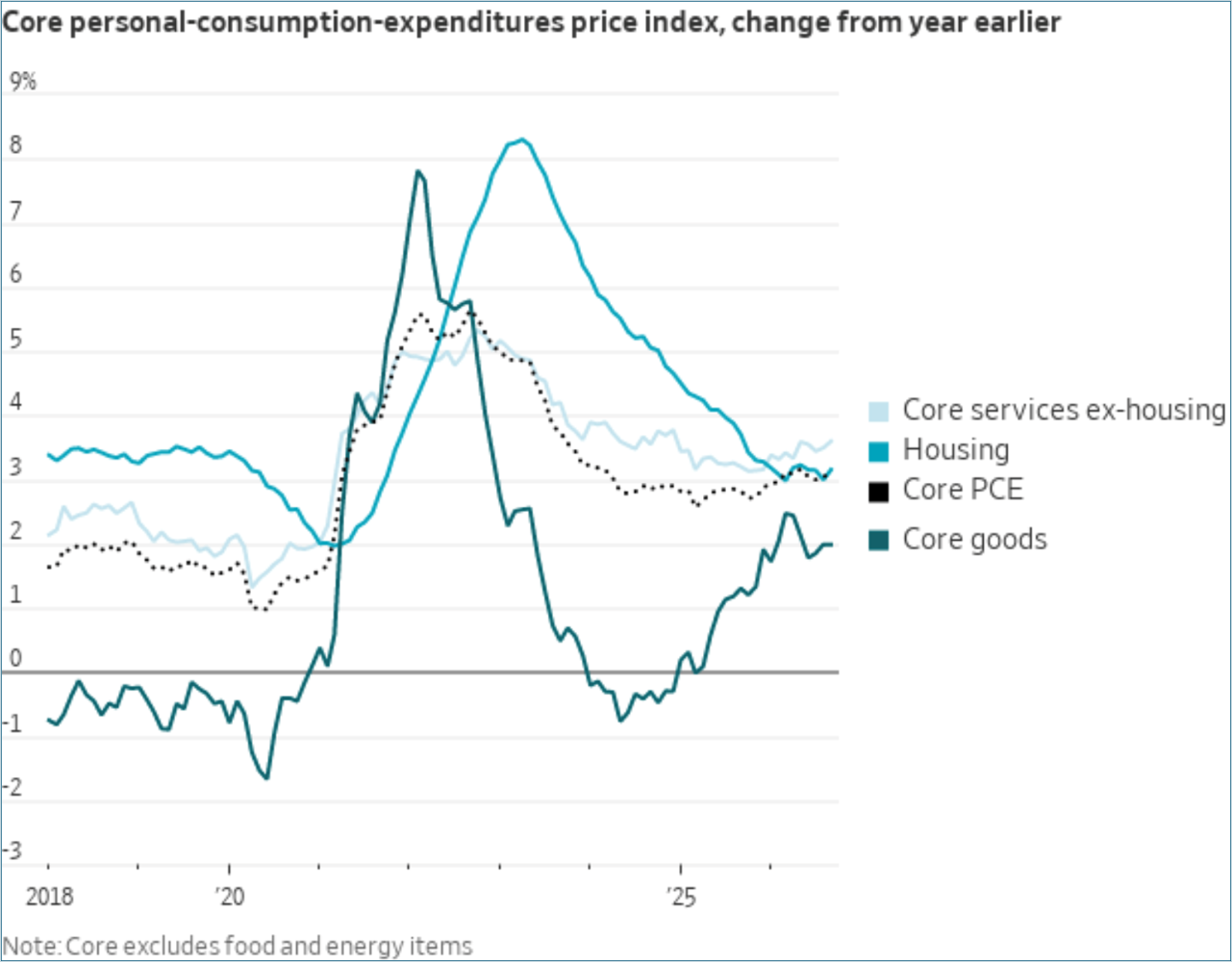 Source: US Bureau of Economic Analysis
Securities offered through the SouthState | DuncanWilliams 1) are not FDIC insured, 2) not guaranteed by any bank, and 3) may lose value including a possible loss of principal invested. SouthState | DuncanWilliams does not provide legal or tax advice. Recipients should consult with their own legal or tax professionals prior to making any decision with a legal or tax consequence. The information contained in the summary was obtained from various sources that SouthState | DuncanWilliams believes to be reliable, but we do not guarantee its accuracy or completeness. The information contained in the summary speaks only to the dates shown and is subject to change with notice. This summary is for informational purposes only and is not intended to provide a recommendation with respect to any security. In addition, this summary does not take into account the financial position or investment objectives of any specific investor. This is not an offer to sell or buy any securities product, nor should it be construed as investment advice or investment recommendations.


