
Are Cracks Appearing in the AI Story?

- The risk off tone from last week has reversed this week. The move began haltingly on Monday but yesterday it gathered more momentum and that led to gains in equities, particularly the Dow which gained 1%. Meanwhile, the more AI-intensive NASDAQ found the gains much more modest. The question nagging investors in those AI-related stocks is whether the stock prices are justified by revenues and profits that are still out in the future. In commodity land oil prices gyrated yesterday with WTI approaching $110/barrel at one point before retreating to $100 and this morning it’s back in the $98 range as the WSJ reports oil flows through the Strait are above pre-war levels. While some are skeptical of that claim one doesn’t “use” oil, but rather refined product such as gas and diesel which are still in short supply; thus, the energy price spike won’t be relenting soon. Currently, the 10yr is yielding 5.10%, down 2bp, while the 2yr is yielding 4.78%, down 1bp on the day.
- We mentioned investors starting to question AI-valuations and the ability to generate sufficient profits to justify those elevated stock prices and CoreWeave is a prime example. The case with CoreWeave involves a second-tier player in the space that’s much more reliant on debt funding for data center buildout than the major hyperscalers that have other mature businesses like Amazon, Google, and Meta. The neocloud firm captured the attention of traders last week, and while its situation still seems to be a one-off and not a broader systemic issue (think Silicon Valley Bank failure vs. Great Financial Crisis), investors, until recently, had an easy time pocketing gains in the sector but are now suddenly forced to question valuations along with mundane things like revenue and profit projections. With interest rates where they are we can expect this type of turbulence to become more frequent.
- The weekly ADP Pulse Report saw private employers add an average of 18,5000 jobs for the week ending October 3 vs. 24,750 the prior week. This is the first week in the last five where we didn’t see a week-over-week gain and is the first week in a month to log less than 20,000 new jobs. What do we make of that? Probably not much as the weekly series is by its high frequency nature fraught with potential volatility. Plus, even at 18,500 new jobs that equates to around 90,000 for the month which would be a decent month of job growth in our relatively static labor force.
- Also yesterday, September Housing Starts were predictably poor with 1.221 million starts annualized vs. 1.288 million in August for a 5.2% decrease in starts. Building permits totaled 1.400 million vs. 1.403 million the prior month for a -0.2% dip in permits. These results follow the Monday release of the National Association of Home Builders sentiment index of builder confidence which dipped to a reading of 29 vs. 31 expected and 32 in September. The 29 reading is the lowest since 2012 and reflected a drop in all three sub-components: Current Sales Conditions (down 2 points to 33), Sales Expectations (down 5 to 32) and Prospective Buyer Traffic (down 5 to 18). It’s no secret that with current mortgage rates in the 7+% range that housing is facing a challenging environment and it doesn’t appear that improvement is on the horizon.
- In another housing report released yesterday it was a similar story as pending home sales in September decreased by 7.3% month-over-month and 11.3% year-over-year, according to the National Association of Realtors. That’s a new all-time low for the series. Month-over-month sales declined in all four major U.S. regions (see graphic below). The West had the largest decrease, followed by the South, Midwest, and Northeast. Year-over-year pending home sales also declined in all four regions.
- NAR Chief Economist Dr. Lawrence Yun commented that, “market conditions weakened in September due to fast-rising mortgage rates. Although job growth and income gains can support home purchases, housing affordability is more affected by changes in mortgage rates. Given that mortgage rates have already risen much more than the Federal Reserve’s short-term interest rate hikes, mortgage rates could be topping out, however, increasing energy prices and the resulting inflationary pressure are highly uncertain. Despite the difficulty of obtaining a mortgage, the limited number of distressed properties is ensuring steady home prices. Thus, buyers and sellers may simply be holding back until mortgage rates move favorably.” The bad news there is that it doesn’t look like lower rates will be riding to the rescue anytime soon.
WTI Oil – Tagged $110/bbl then Retreated Below $100 Yesterday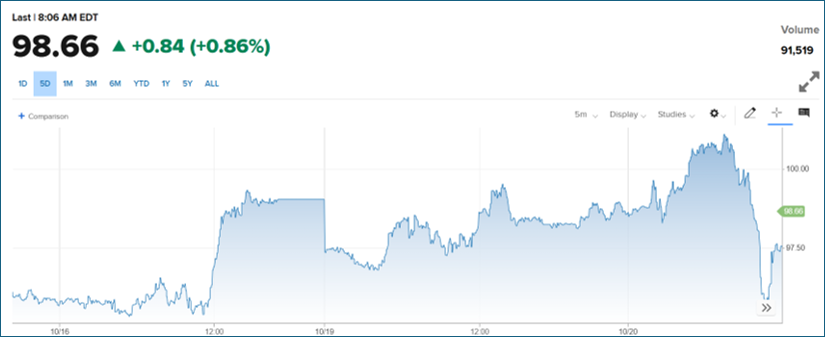 Source: CNBC
CoreWeave’s Credit Default Swap Prices Reflect Increasing Credit Concerns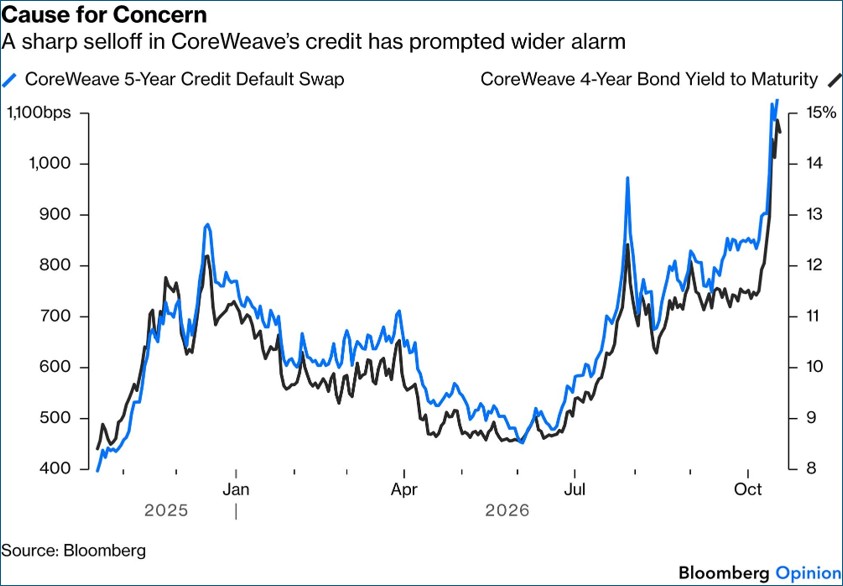 Source: Bloomberg
October Home Builder Sentiment – Approaching GFC-Level Gloom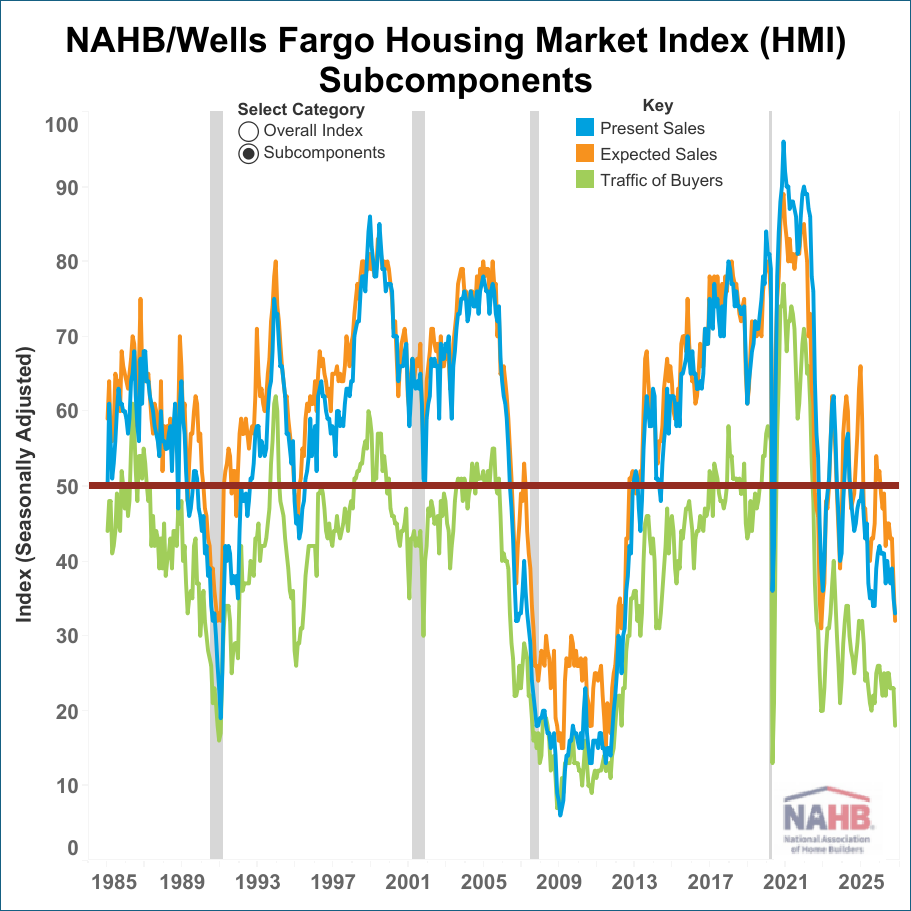 Source: NAHB
Pending Home Sales in September – Down in all Regions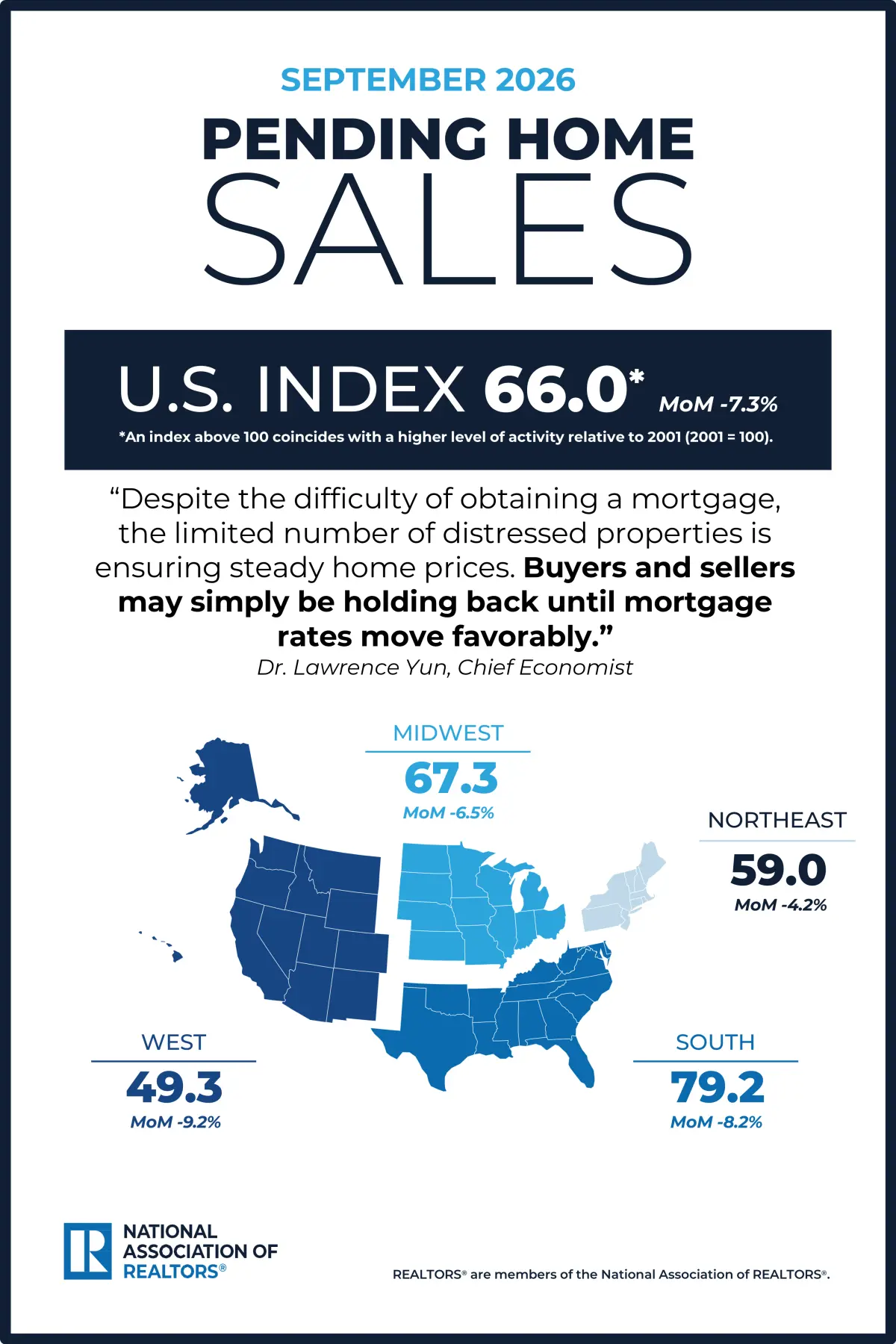 Source: National Assoc. of Realtors
Securities offered through the SouthState | DuncanWilliams 1) are not FDIC insured, 2) not guaranteed by any bank, and 3) may lose value including a possible loss of principal invested. SouthState | DuncanWilliams does not provide legal or tax advice. Recipients should consult with their own legal or tax professionals prior to making any decision with a legal or tax consequence. The information contained in the summary was obtained from various sources that SouthState | DuncanWilliams believes to be reliable, but we do not guarantee its accuracy or completeness. The information contained in the summary speaks only to the dates shown and is subject to change with notice. This summary is for informational purposes only and is not intended to provide a recommendation with respect to any security. In addition, this summary does not take into account the financial position or investment objectives of any specific investor. This is not an offer to sell or buy any securities product, nor should it be construed as investment advice or investment recommendations.


