
Bond Portfolio Trends: First Quarter 2026

Examining Bond Portfolio Trends: First Quarter 2026
- Beginning in May 2012, we started tracking portfolio trends of our bond accounting customers here at SouthState Securities. At present, we account for over 130 client portfolios with a combined book value of $12.4 billion (not including SouthState Bank’s portfolio), or $95 million on average per portfolio. Twelve months earlier, the average portfolio size was $87 million, representing a 9% increase during the year.
First Quarter 2026 Market Observations
- The first quarter of 2026 was characterized by a Fed standing pat on rate cuts after cutting three times in the fourth quarter of 2025. Inflation concerns returned during the quarter, especially in March with the onset of the Iran war and concerns over oil and other petroleum supplies. This concern moved oil prices higher and along with them market rates moved higher as well. Yet, the rate moves were somewhat contained as inflation concerns were met with increasing growth anxiety which kept upward yield moves limited.
- Also, the short end of the curve saw yields creep higher as rate cut expectations were pushed out towards the end of 2026, with 2027 starting to look more like the next likely rate cut possibility. This pushed the 2yr yield from near 3.50% – 3.60% as the quarter began to near 4.00% in March as inflation worries peaked and rate cut odds fell hard. Since that 4.00% peak, yields have drifted down to the 3.80% level as rate cuts are still a longshot but increasing growth worries are keeping short maturity yields on a tight leash much like longer duration maturities.
- During the quarter, the 10yr Treasury yield ended 15bps higher reflecting the push and pull between inflation concerns and slower growth expectations. Meanwhile, the 2yr Treasury finished the quarter 32bps higher as near-term rate cut expectations were thoroughly dashed as inflation worries dominated the early weeks of the war. With that backdrop, let’s turn our attention to changes in portfolio allocations during the past year.
Changes in Portfolio Allocations
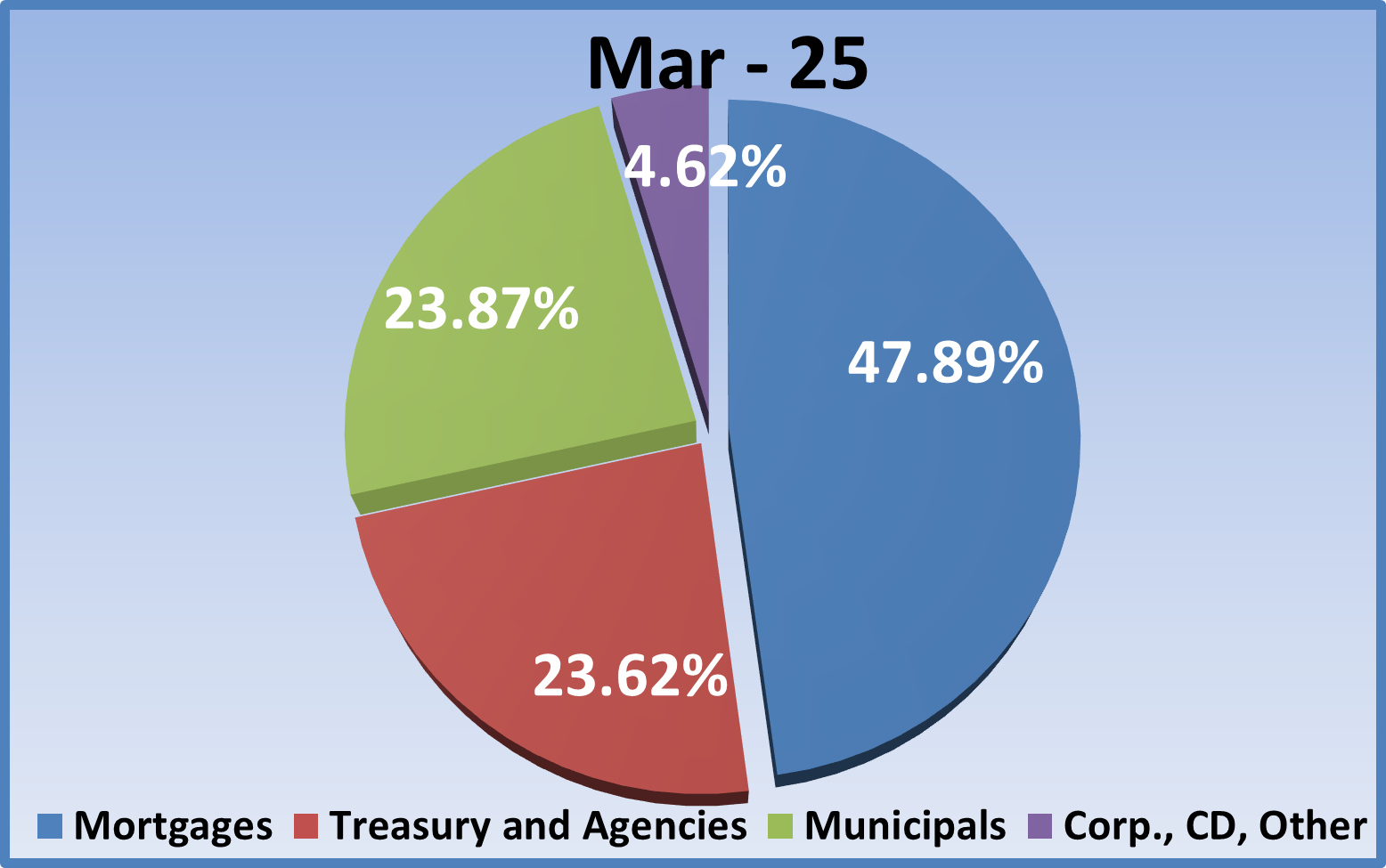
- Let’s begin our portfolio review by revisiting allocations a year ago as shown in the pie chart below. The MBS/CMO sector comprised 48% of the portfolio, Agency/Treasury investments were 24%, municipal allocations also stood at 24%, and the “Other” category (CDs, corporates, and other floaters) 4.6%.
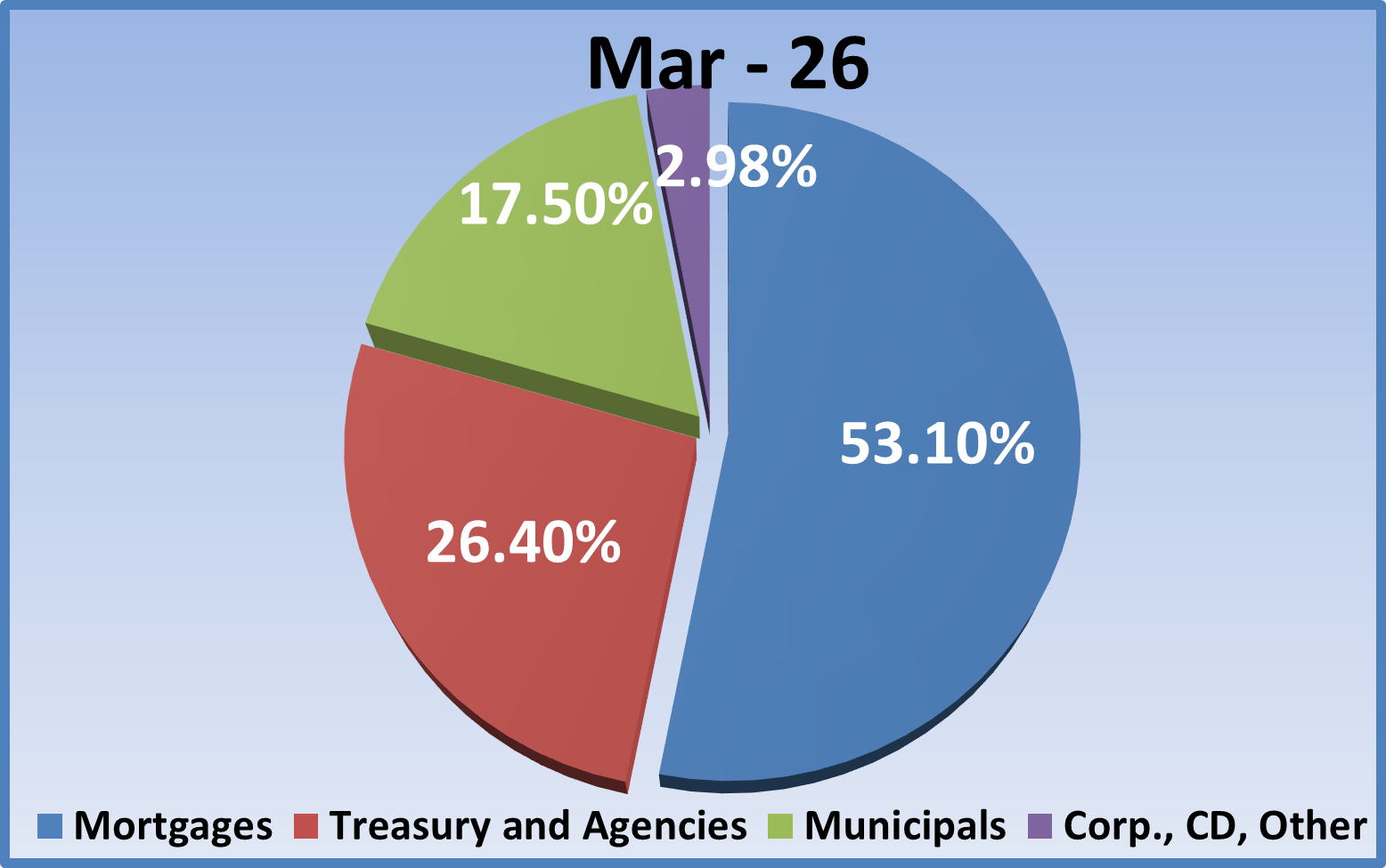
- Fast forward one year to March 31, 2026. The MBS/CMO sector comprised 53% of the portfolio, a solid 5% increase from last year. This repeats the experience of the past year which halted a prior multi-year trend of declining MBS allocations. Before the Fed’s rate hiking cycle begun in 2022, MBS tended to lead portfolio investments by a wide margin, close to 50% of total allocations, and we are back to that level again.
- The Agency/Treasury sector had been the one area that experienced increased allocations during the hiking cycle, but while leading the way in new quarterly purchases, the overall allocation held relatively steady, declining slightly from 24% a year ago to 23%. The “Other” category was smaller at 3% versus 4.6% a year ago with corporate debt constituting more than 80%.
- Municipal investments saw modest increases in allocation throughout 2024, but in 2025 additional investments slowed as investors shifted focus to MBS over municipal securities, perhaps due to duration concerns and this pattern persisted in the first quarter of 2026 with municipal allocations down to 18% vs. 24% a year ago.
Changes in Portfolio Performance
Now let’s look at portfolio performance trends. The graph below tracks average portfolio tax-equivalent book yield, duration, and unrealized gain/(loss) as a percent of book value. It also tracks 10-year Treasury yields and average portfolio size over the last two years.
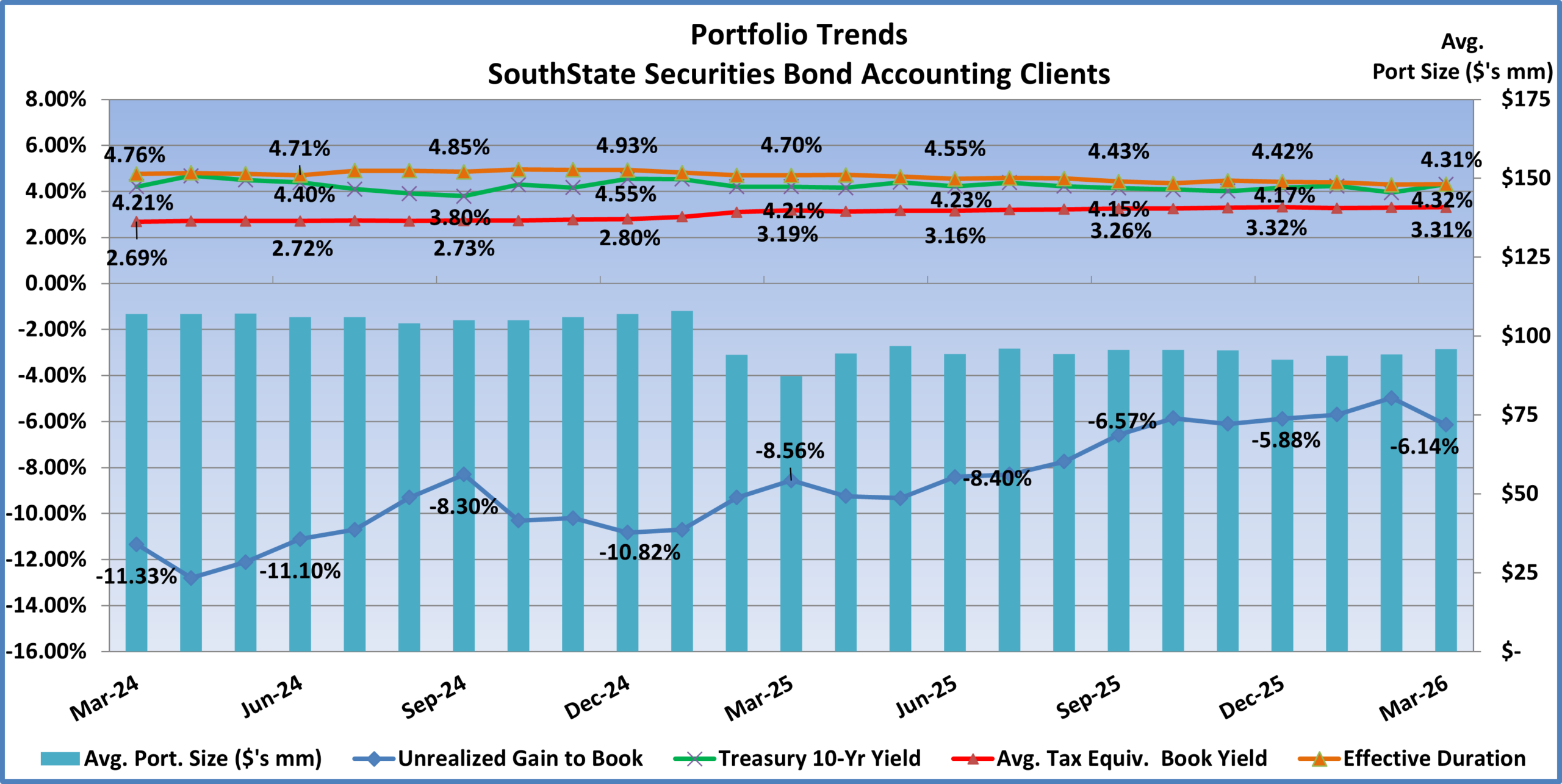
- Portfolio yields averaged 3.19% (red line) a year ago. Yields have risen through the year as reinvestments were made at higher market yields. By the end of the first quarter this year, yields had increased 12bps to 3.31%. We had previously seen 6 to 8bps in quarterly yield improvement but in the past year that has slowed to 3bps per quarter as market yields stabilized and lower legacy yields are slow to be replaced.
- 10-year Treasury yields (green line) a year ago were 4.21% and have moved little in the past twelve months as investors waffled between worried over inflation and growth. The 10yr yield ended the first quarter at 4.32%, a modest 11bps increase during the year.
- Average duration a year ago was 4.70 years and trended lower throughout 2025 and ended the year at 4.42 years as new investments generally were of the shorter duration variety. The average duration at the end of the first quarter dipped again to 4.31 years and is the lowest since August 2021 and well off the 5.50 year high when rate hikes began in March 2022.
- While the average duration dipped during the quarter, market rates inched higher on war-driven inflation concerns and that contributed to a quarterly increase in unrealized losses. In the first quarter, the unrealized loss initially improved from –5.88% to –4.97% as a percent of book in February. That stands as the lowest unrealized loss in four years, just before the Fed began its hiking cycle in March 2022. Alas, with the closing of the Strait of Hormuz, inflationary concerns in March caused a modest back-up in market yields which widened the unrealized loss to -6.14% of book, wiping out the modest improvement in January and February.
Portfolio Purchases During the First Quarter 2026
- New investments during the first quarter increased slightly from the fourth quarter’s $1.4 billion to $1.5 billion, or $11.4 million in purchases per portfolio. By way of comparison, in the first quarter 2025, purchases totaled $1.02 billion, or $7.8 million per portfolio. So, quarterly purchases continue to increase which is a trend that began when the Fed shifted from rate hikes to cuts in late 2024. The run rate of purchases prior to the pandemic was approximately $1.2 billion per quarter and this is the third straight quarter where purchases have exceeded pre-pandemic levels.
- The increase in quarterly purchases has become enough to replace portfolio run-off; thus, average portfolio size has stabilized and is moving slightly higher.
- After two quarters trailing the Treasury/agency sector, the MBS/CMO/SBA sector led purchases in the first quarter with 51% of the total. The Treasury/agency sector followed with 47% of total purchases (44% Treasury, 3% agency). The municipal sector was once again lapped by the top two categories with just 1.4% of purchases, (1.1% tax-free, 0.3% taxable). The 1.4% in muni purchases compares to a 18% legacy muni allocation.
- Average tax-equivalent book yield for first quarter purchases was 4.20% vs. 4.15% in the prior quarter. The average effective duration was 2.85 years versus 3.06 years in the prior quarter. So, investors earned a bit more yield despite slightly shorter duration purchases vs. the fourth quarter which is an indication of the upward tilt of market yields during the quarter.
- However, compare those quarterly metrics to the legacy portfolio book yield of 3.31% and effective duration of 4.31 years.
- We’ll be back in July with a review of second quarter performance and purchases.
Securities offered through the SouthState | DuncanWilliams 1) are not FDIC insured, 2) not guaranteed by any bank, and 3) may lose value including a possible loss of principal invested. SouthState | DuncanWilliams does not provide legal or tax advice. Recipients should consult with their own legal or tax professionals prior to making any decision with a legal or tax consequence. The information contained in the summary was obtained from various sources that SouthState | DuncanWilliams believes to be reliable, but we do not guarantee its accuracy or completeness. The information contained in the summary speaks only to the dates shown and is subject to change with notice. This summary is for informational purposes only and is not intended to provide a recommendation with respect to any security. In addition, this summary does not take into account the financial position or investment objectives of any specific investor. This is not an offer to sell or buy any securities product, nor should it be construed as investment advice or investment recommendations.


