Early Labor Numbers Look OK

- The first of the labor-related numbers for July are starting to arrive but plenty more will populate spreadsheets between now and Friday. From what we’ve seen so far, and think will continue, the labor market remains in decent shape with supply and demand roughly in balance. That will give the Fed some room to focus on its price stability mandate as it sifts through inflation data prior to the September FOMC meeting and a potential rate hike. Despite this being the week of jobs data, the market may already be looking ahead to next Wednesday’s July CPI report as the next consequential release. Currently, the 10yr is yielding 4.62% down 1bp, while the 2yr is yielding 4.21%, up 1bp on the day.
- The ADP Employment Change report just posted private sector job growth for July at 44 thousand vs. 65 thousand expected and 95 thousand in June (adjusted from 98 thousand). As usual, job gains were strongest in healthcare at 36 thousand while financial services added 10 thousand jobs and 9 thousand in professional/business services. Interestingly, leisure/hospitality lost 11 thousand and trade/transportation activities lost 8 thousand. Perhaps a sign of softening in the travel/experience market?
- Annual wage growth for Job Stayers was 4.4%, matching the May and June gain, while annual wage growth for Job Leavers was 7.0% vs. 6.6% in June. Annual wage gains had been trending lower since peaking at 8% (job stayers) and 16% (job leavers) in 2022. Over the past year, however, wage gains have been stable with a slight deceleration noted. For example, a year ago, annual wage gains for job stayers were 4.5% and for job leavers 7.0%. The increase in July from 6.6% to 7.0% for job leavers does point to a recent upward move in demand which will be interesting to see if it sticks (see graph below).
- Yesterday, another labor-related report but for June, the Job Opening and Labor Turnover Survey (JOLTS), reported job openings at 7.359 million available positions, down from the 7.537 million in May and just shy of the 7.454 million expected. The Layoff Rate (layoffs to total employed) remained unchanged at 1.1%. It touched a low of 1.0% in January and November in the past year and the stability of the rate shows that the low-fire environment continued in June, despite the disappointing nonfarm payrolls report from that month.
- The Quits Rate (voluntary separations to total employed) stayed at 2.0% where it has been for three of the last four months. A 1.9% rate in April matched the low set in February and last October and September and remains the lowest rate since 2020 and the Covid lockdowns. The rate is a measure of worker confidence in finding better/higher paying employment (i.e., a higher rate indicates more confidence in voluntarily quitting and finding another job), so the stable reading in June indicates status quo confidence since April, but it’s probably more accurate to call the movement between 1.9% and 2.0% in the past year as indicative of a labor market close to equilibrium.
- At 10am ET, the ISM Services Survey for July will be released. Expectations are for the headline reading to increase slightly from 54.0 to 54.5, indicating slight improvement in the expanding sector. The sub-indices such as Prices Paid (65.0 expected vs. 67.7 in June), New Orders (56.0 expected vs. 55.1) and Employment (51.0 expected vs. 51.2) will be updated as well. On net, expectations are that the service side of the economy continued in expansion mode for July with a slight improvement in prices paid vs. June.
- Yesterday, the July ISM Manufacturing Index printed at a four-year high of 55.6 vs. 53.9 expected and 53.3 prior. The Employment sub-index improved to 52.8 vs. 50.0 expected and 49.7 previous. This was the first employment reading in expansionary territory (>50) since September 2023, and the highest since August 2022. What’s more, the Prices Paid index declined to a five-month low 71.1 vs. 71.0 anticipated and 73.0 before. Finally, the New Orders index ticked up to 56.7 from 56.0. Commentary in the release noted that, “In July, 38% of comments were positive and 62% negative, with a 1-to-1.6 ratio of positive to negative sentiment. Pricing volatility was mentioned in 57% of negative comments, the Iran war 43%, increasing lead times 22% and tariffs slipped to 18%.” On balance, a solid report that builds on the rebound in 2026, that now finds seven straight months above the 50 breakeven line.
ADP Reported Wage Gain Increase for Job Leavers in July from 6.6% to 7.0% – Hints at Increased Demand for Some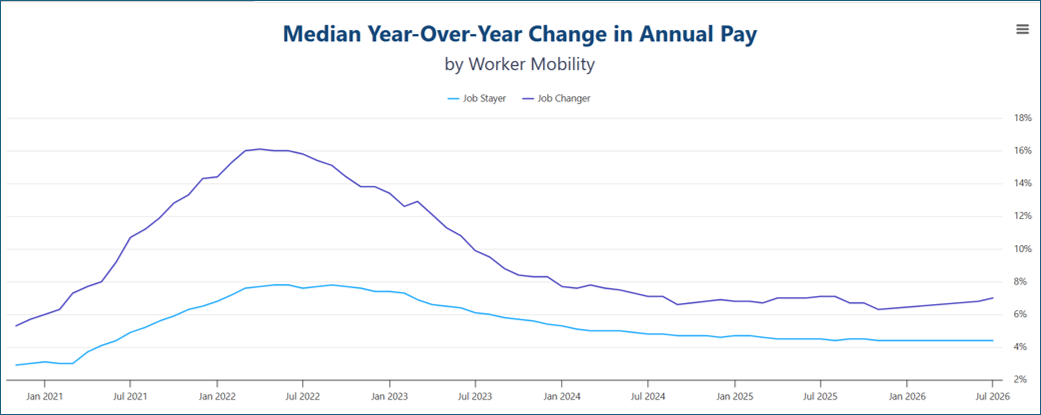 Source: ADP
June JOLTS: Job Openings Drift Lower but Still Higher Than Total Unemployed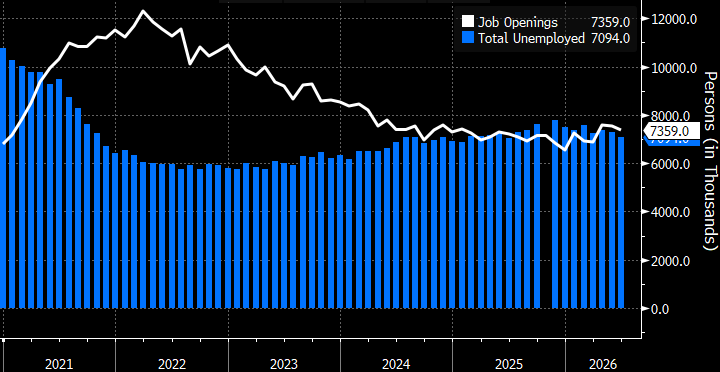 Source: BLS
June JOLTS: Stable Layoff and Hiring Rates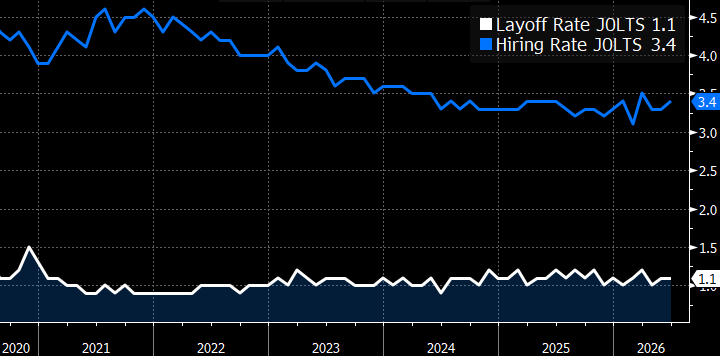 Source: BLS
ISM Manufacturing: Improves in July with More Orders and Employment, Lower Prices Paid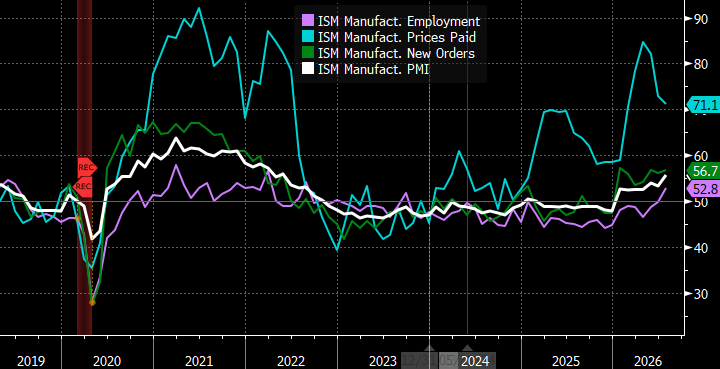 Source: Institute of Supply Management
Securities offered through the SouthState | DuncanWilliams 1) are not FDIC insured, 2) not guaranteed by any bank, and 3) may lose value including a possible loss of principal invested. SouthState | DuncanWilliams does not provide legal or tax advice. Recipients should consult with their own legal or tax professionals prior to making any decision with a legal or tax consequence. The information contained in the summary was obtained from various sources that SouthState | DuncanWilliams believes to be reliable, but we do not guarantee its accuracy or completeness. The information contained in the summary speaks only to the dates shown and is subject to change with notice. This summary is for informational purposes only and is not intended to provide a recommendation with respect to any security. In addition, this summary does not take into account the financial position or investment objectives of any specific investor. This is not an offer to sell or buy any securities product, nor should it be construed as investment advice or investment recommendations.


