
Fed and Data Will Be Quiet This Week

- While we had quite the smorgasbord of information last week, from inflation reports to the new Fed Chair testifying on Capitol Hill for two days, this week offers something a bit less compelling. The Fed has gone into its pre-FOMC meeting blackout, and the calendar is devoid of any consequential releases. Thus, we’re stuck focusing on Middle East headlines and perhaps more developments out of the equity markets to guide trading this week. Early news on the Middle East is that despite the escalation of attacks, rumors are diplomatic efforts are resuming, and that little bit of positive news has equities set to open higher with Treasuries a touch higher in yield to start the week. Currently, the 10yr is yielding 4.55% up 2bps, while the 2yr is yielding 4.19%, up 1bp on the day.
- First, let’s recap the preliminary University of Michigan Sentiment Survey for July that was released late Friday morning. The overall sentiment measure rose to 54.4, easily beating the 51.0 expectations and well clear of the 49.5 reading in June as easing price pressures at the pump led to the jump. That seems to be the case with the UMich survey in that it’s closely correlated with the price of gas. It’s the highest sentiment measure since February (coinciding when the Iran war and higher gas prices started) but remains 12% lower from a year ago. The other measures were also well ahead of expectations. Current Conditions increased from 47.7 to 54.9 with the Expectations index increasing from 50.7 to 54.0. The survey was taken between June 23 and July 13, so the uptick in oil and gas prices this month (+19.43% mtd., and AAA national average back at $4.00/gal) may make the July bounce in sentiment a short-lived phenomenon.
- Year-ahead inflation expectations dipped from 4.6% in June to 4.2% and below the 4.5% expectation. Even with the July dip, the reading substantially exceeds the 3.4% reading seen in February prior to the start of the Iran war, along with all 2025 readings and the 2.3-3.0% range seen in the two years pre-pandemic. Long-run inflation expectations, as forecast, stayed at 3.3%, same as in June. In 2024, values ranged between 2.8% and 3.2%, while in 2019-2020, they were consistently below 2.8%. So, while long-run inflation expectations are more or less “well anchored”, the Fed would like for it to dip back into 2-handle range and ideally slide back closer to its 2% target.
- Later this morning the June Leading Index will be released. The problem is this data series has lost a ton of credibility in the post-pandemic period as it has been predicting a recession for nearly two years. It’s a prime example of an index that was flashing yellow for a recession for more than a year. So, take whatever you want from the report, but we’ll move onto other items.
- On Friday, the first of July activity numbers will arrive with the Preliminary S&P Global PMI series. While it’s not as well-known as the ISM series that arrives in the first week of the month, it’s a well-regarded look at both the manufacturing and services side of the economy. The manufacturing series printed a solid 53.9 in July, easily in expansion territory but plenty of the strength was focused on firms building inventory ahead of expected price increases due to the Iran war. We’ll see if that activity continued in July. The services series was bit softer at 51.2 but still in expansion territory.
- June New Home Sales due on Friday finishes the brief calendar of economic releases for the week. Sales are expected at 600 thousand annualized vers 580 thousand last month. As the graph below shows, the 580 thousand from May was a yearly low and near a low dating back five years. Thus, the housing market, even with the slight uptick in expected June sales, remains moribund as activity is stymied by high rates and low inventories and that doesn’t appear to be changing anytime soon.
UMich Preliminary July Survey – The Equity-Owning Consumer Continues to Feel Better than Others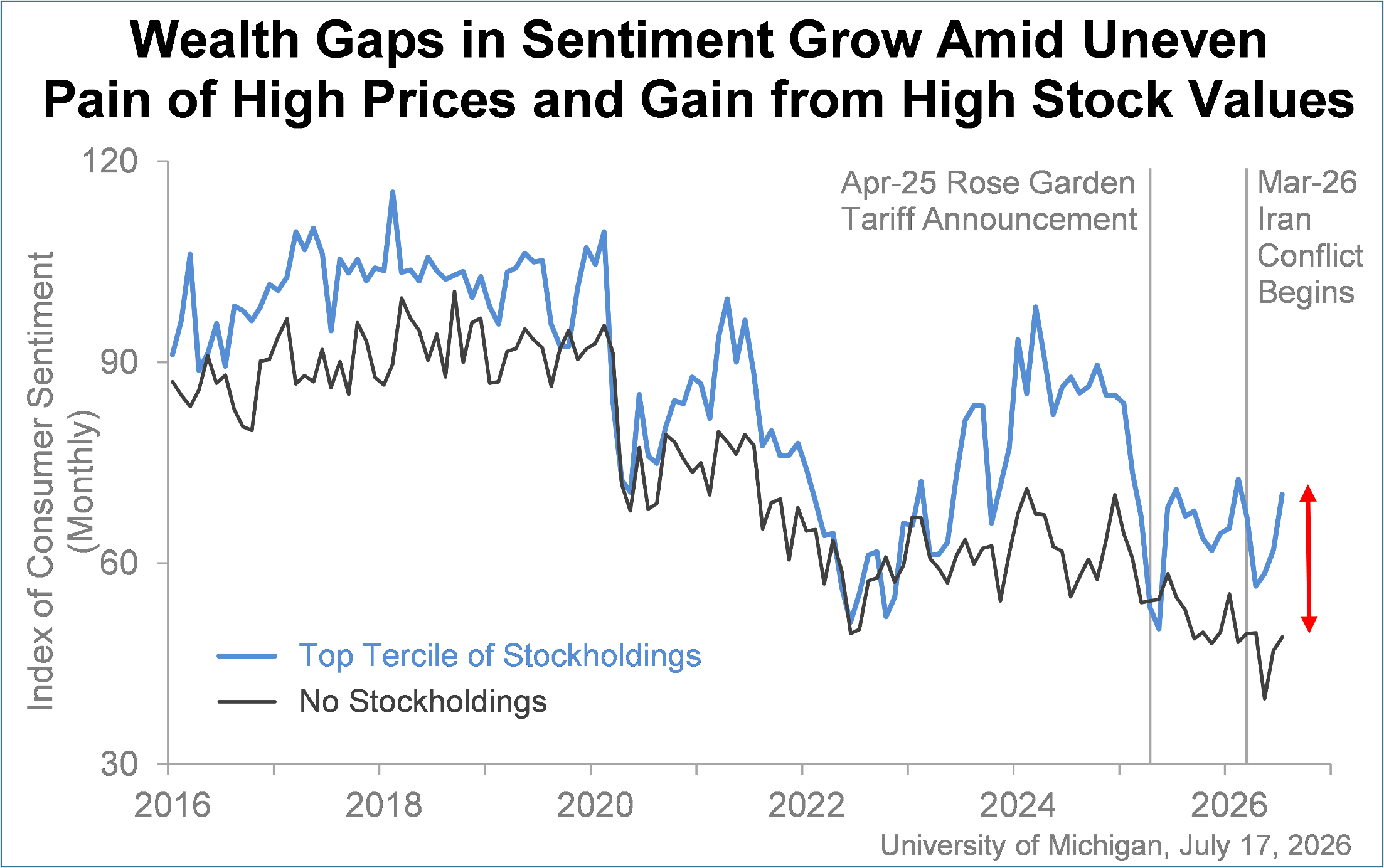
Source: Univ. of Michigan
Univ. of Michigan July Consumer 5-10 Inflation Expectations – Steady at 3.3%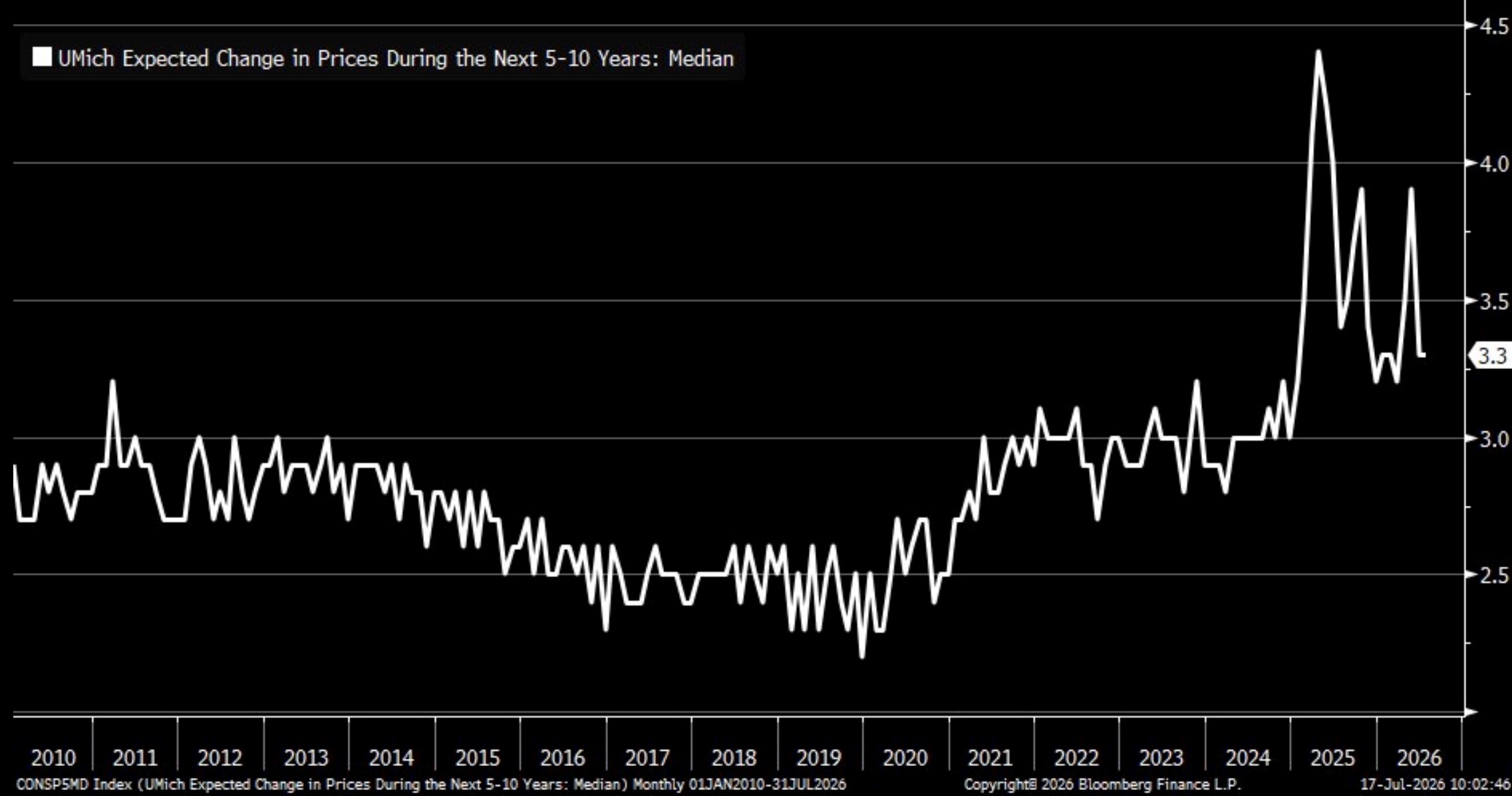
Source: Univ. of Michigan
Meanwhile, Oil Price Gain in July up 19.43% – That Uptick in Sentiment may be Short-Lived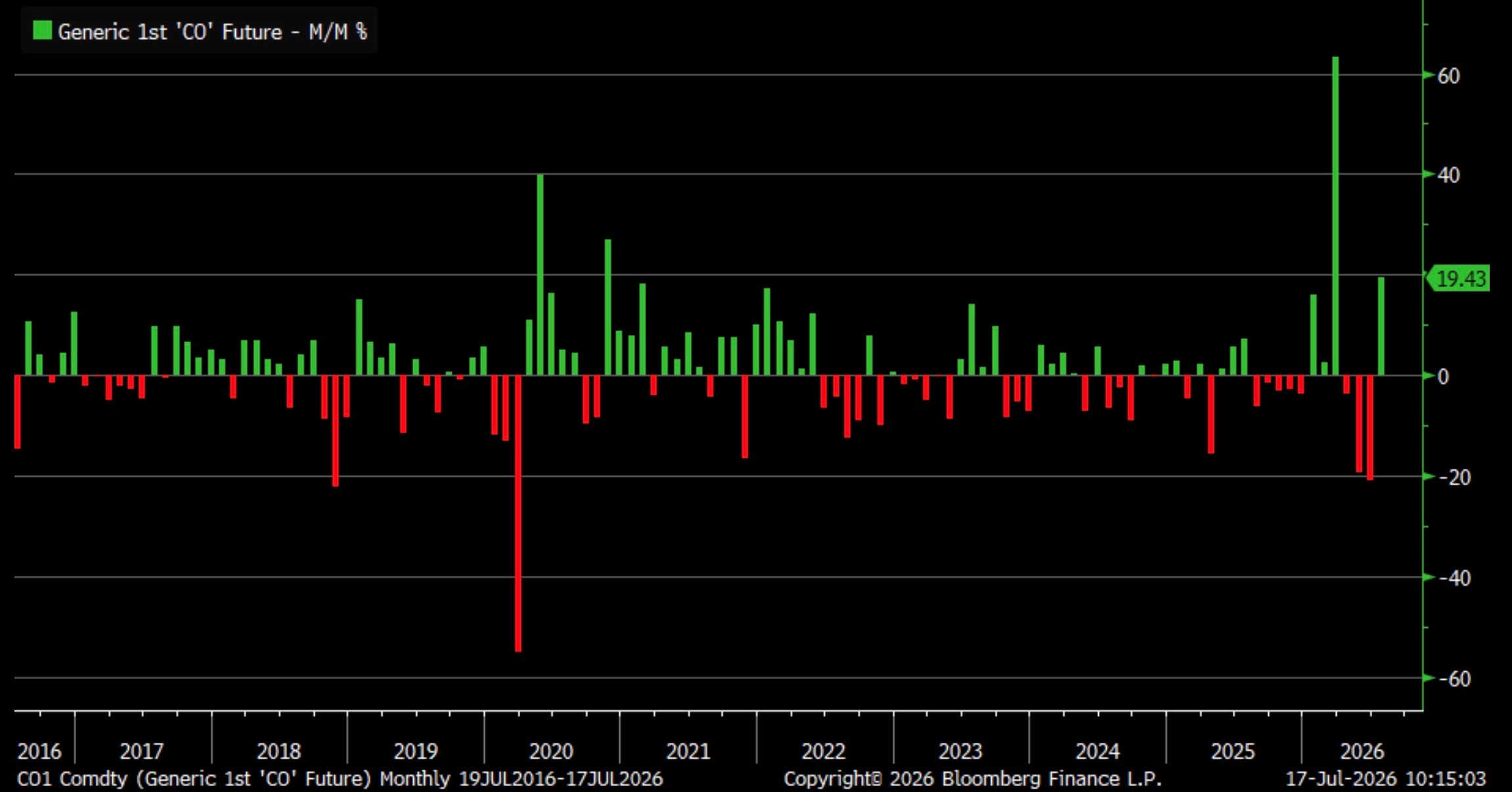
Source: Bloomberg
Univ. of Michigan July Consumer Expectations Index – Improves to 54.0 as Gas Prices Drop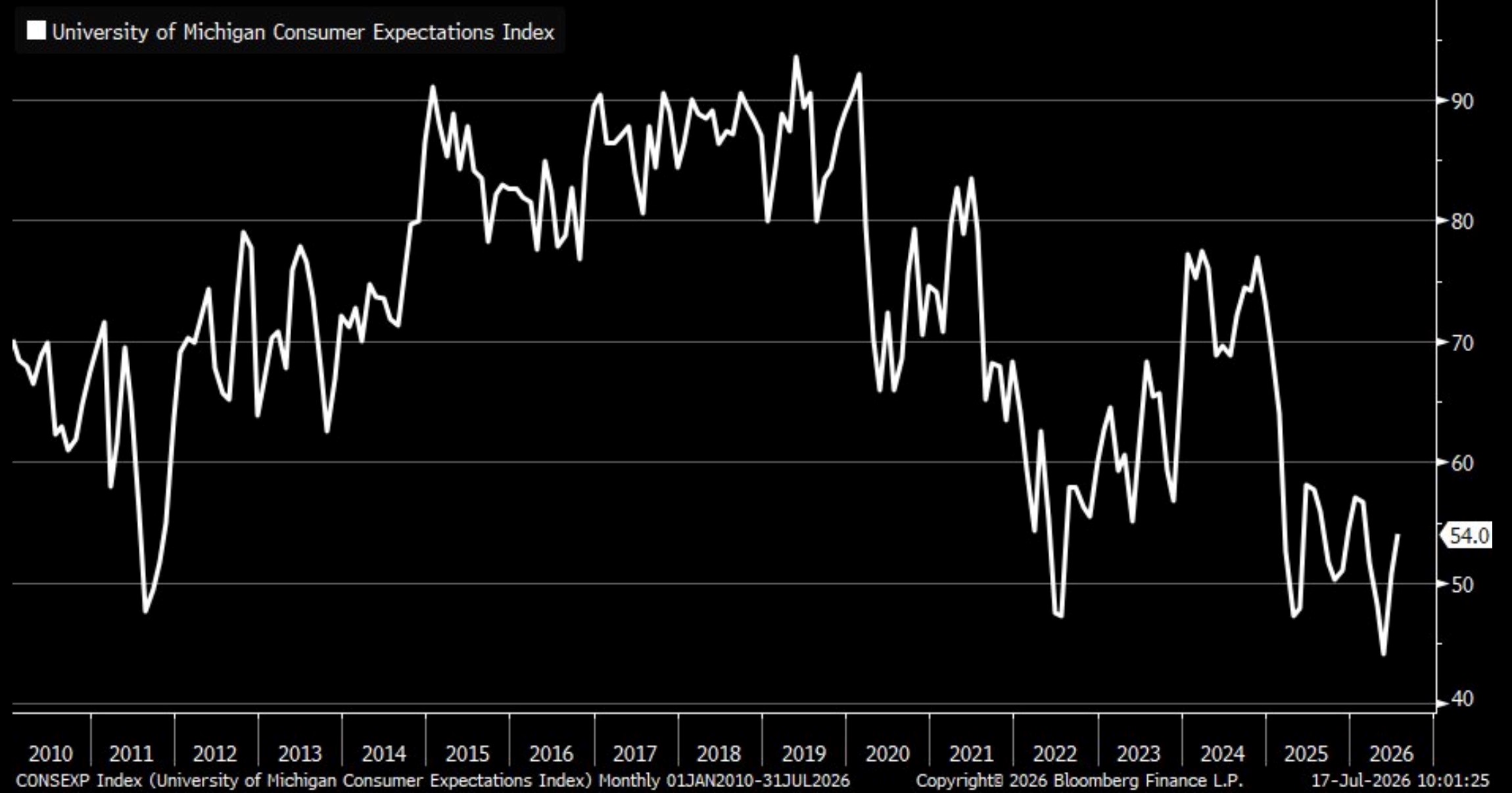
Source: Univ. of Michigan
Securities offered through the SouthState | DuncanWilliams 1) are not FDIC insured, 2) not guaranteed by any bank, and 3) may lose value including a possible loss of principal invested. SouthState | DuncanWilliams does not provide legal or tax advice. Recipients should consult with their own legal or tax professionals prior to making any decision with a legal or tax consequence. The information contained in the summary was obtained from various sources that SouthState | DuncanWilliams believes to be reliable, but we do not guarantee its accuracy or completeness. The information contained in the summary speaks only to the dates shown and is subject to change with notice. This summary is for informational purposes only and is not intended to provide a recommendation with respect to any security. In addition, this summary does not take into account the financial position or investment objectives of any specific investor. This is not an offer to sell or buy any securities product, nor should it be construed as investment advice or investment recommendations.


