
How Contentious was the FOMC Decision to Pause?

- The minutes from the July FOMC meeting await us this afternoon. I know, riveting stuff. Anyway, with the subsequently released cool July inflation report, weak jobs and retail sales reports, the decision to pause seems validated. The minutes, however, will still provide some insight into how vigorous the hiking debate was, and recall there were three members who voted to hike. Meanwhile, the final piece of inflation news that fits into the PCE puzzle arrived yesterday with Import/Export Prices for July. Prices ex-oil came in higher than expected but a drop in foreign airfares may keep the monthly core PCE reading at a 0.2% increase which would align with the other rather benign inflation reports of late. So, if it’s not the fear of inflation what other catalysts are forcing yields higher? That’s a question we attempt to tackle below. Currently, the 10yr yield is 4.65%, down 6bp, while the 2yr is yielding 4.15%, down 3p on the day
- This afternoon, the FOMC minutes from the July meeting will be released. The focus will be on assessing the mood of the members who voted for a pause, and the degree to which the discussion leaned towards hiking or not. All that said, with the softish July CPI report following a cool June report, coupled with the weak jobs and soft retail sales report, the bar to a rate hike has no doubt risen since the meeting. Thus, readers should compare the minutes with those recent reports and adjust comments/conclusions accordingly.
- The penultimate July inflation report was delivered yesterday with July Import/Export Prices. The Import Index unexpectedly decreased -0.4% vs. 0.1% forecasted and June’s downwardly revised -0.3% result (originally reported as 0.3%). The YoY rate decreased from 6.7% to 5.9%. Ex-petroleum, import prices rose 0.3% vs. 0.1% expected and above the downwardly revised 0.2% gain in June (originally reported as a 0.5% increase). Monthly price gains by country were as follows: China (+0.8%, largest monthly gain since 2008 but YoY at 2.7%), Japan (+0.6%, 1.7% YoY), Mexico (+0.3%), Canada (-2.1%, first decline since 9/25).
- One piece of good inflation news was foreign airfares which fell 11.0% vs. up 12.6% in June and 11.3% in May. Obviously, World Cup fever had something to do with the price runup and subsequent unwind in July. That airfare piece is included in PCE, so, while it may not be weighted much it should keep the expected 0.2% core PCE gain from moving into 0.3% territory. Our monthly caveat to this report is that price changes are before tariff expenses, so it reflects true offshore pricing for domestic purchasers. Any tariff impact will be in addition to the price moves listed here. Meanwhile, export prices were cheaper as well, with monthly prices down –1.3% vs. 0.0% expected, and below the -0.7% dip in June. The monthly price decrease was due to lower oil prices. The YoY gain, however, remained stout at 8.2% vs 10.2% the prior month. That price increase is primarily an oil story but not solely as ag prices were up 5.7% YoY.
- Also yesterday, the weekly ADP Pulse Report saw private employers add an average of 9,500 jobs over the four weeks ending August 1st vs. 8,250 the prior week. This is the first week-over-week gain in the series since June and speaks to the ongoing low-hire, low-fire environment we’ve been in since about forever, it seems.
- With all that said, the above reports did little to shift the mood and direction in financial markets. Yields continue to drift higher and there is a grab-bag of reasons for it, and inflation isn’t really one of them. TIPS inflation breakeven rates have been steady to declining this summer, so the yield backups are coming from other sources.
- First, term premiums are increasing given the more unsettled nature on the geo-political front, not to mention the lack of forward guidance from the Fed. More uncertainty = higher yields.
- Next, global sovereign yields are moving higher, meaning global yields can compete more effectively against Treasuries (see graph below).
- Fiscal deficits are an evergreen excuse for higher yields, especially as they continue to widen. Back in the US, debt service to GDP has hit an all-time high, which is another result of widening fiscal deficits (see graph below).
- Corporate debt issuance is heavy as AI data center buildouts continue, providing more competition for Treasuries.
- Finally, the US aided Japan in defending its currency and has promised to do more. With the yen currently around 160USD, right where past interventions happened, the risk of selling US debt/currency to prop up the yen is another element in the higher yield story.
Import Prices Ex-Petroleum (YoY) – Heading the Wrong Way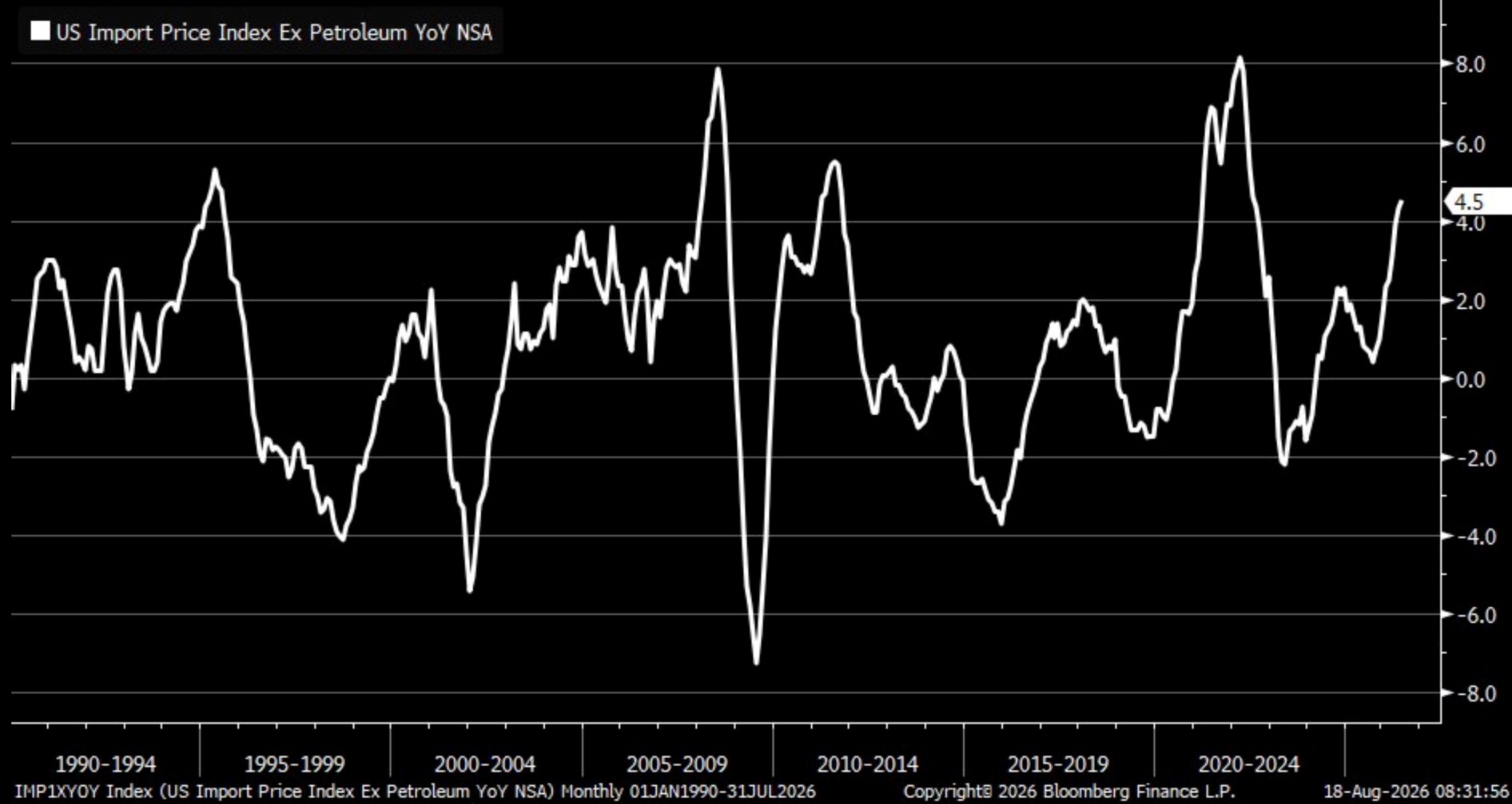 Source: BLS
Sovereign 10Yr Debt Tells the Same Story – Higher Yields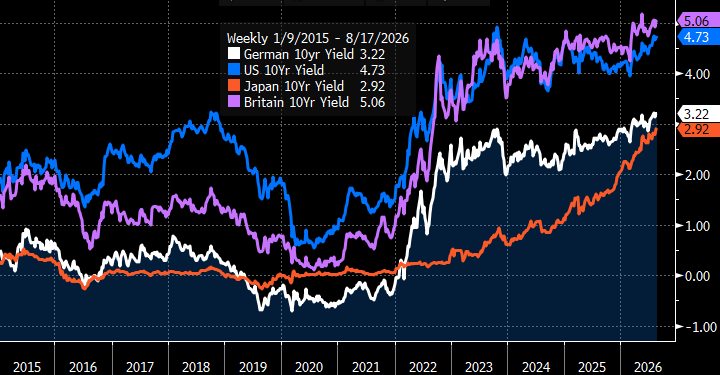 Source: Bloomberg
Yield Increase is not an Inflation Story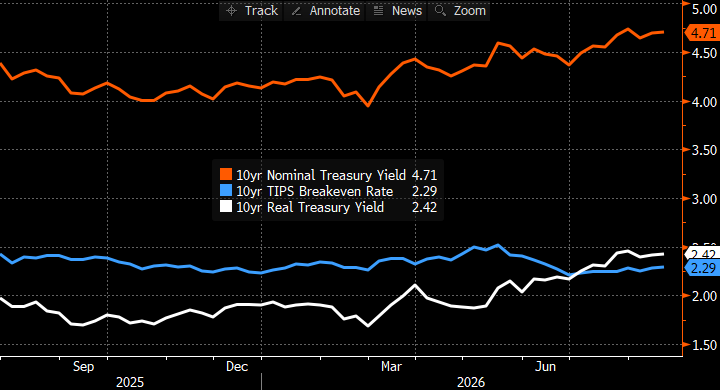 Source: Bloomberg
Public Debt Service to GDP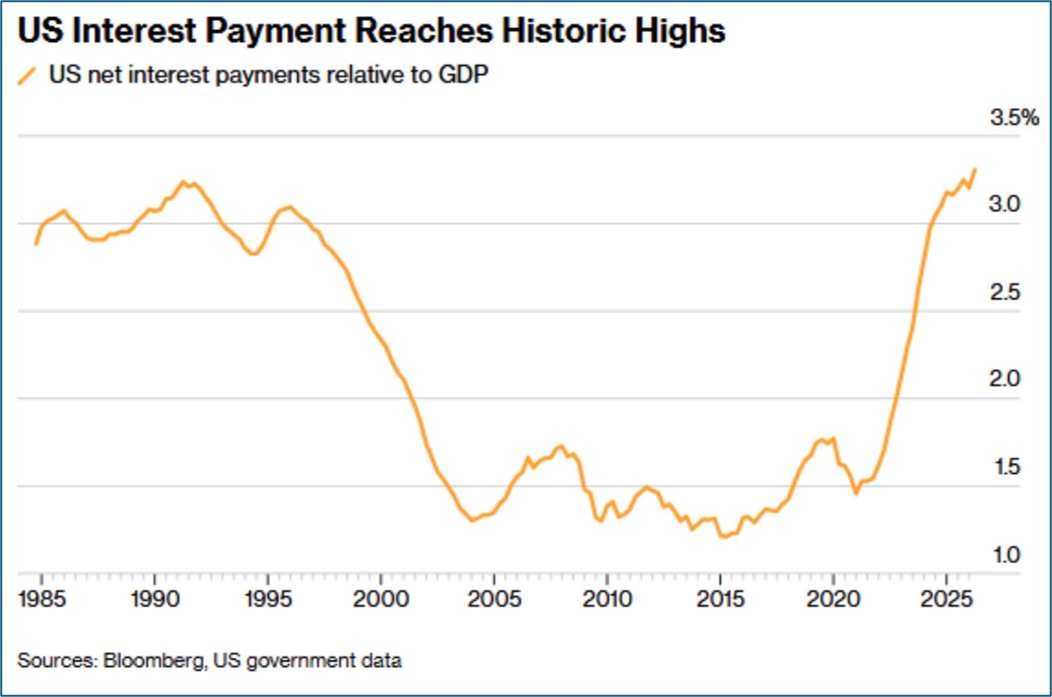 Source: Bloomberg
Securities offered through the SouthState | DuncanWilliams 1) are not FDIC insured, 2) not guaranteed by any bank, and 3) may lose value including a possible loss of principal invested. SouthState | DuncanWilliams does not provide legal or tax advice. Recipients should consult with their own legal or tax professionals prior to making any decision with a legal or tax consequence. The information contained in the summary was obtained from various sources that SouthState | DuncanWilliams believes to be reliable, but we do not guarantee its accuracy or completeness. The information contained in the summary speaks only to the dates shown and is subject to change with notice. This summary is for informational purposes only and is not intended to provide a recommendation with respect to any security. In addition, this summary does not take into account the financial position or investment objectives of any specific investor. This is not an offer to sell or buy any securities product, nor should it be construed as investment advice or investment recommendations.


