
Jobs Week Arrives

- After last week’s full calendar, with an FOMC meeting and the latest GDP and inflation figures, attention shifts to the full employment side of the Fed’s mandate with job-related reports. It must be said, however, that with inflation the current focus of the Fed, and clearly driving the hike/no hike bus, this week’s data flow won’t be as impactful with a labor market that has shown, and is expected to continue showing, surprising resilience; but we will see if any surprises await on that front. Speaking of fronts, the US has called off “massive attacks” in Iran as Trump signaled negotiations with Iran are resuming today. It seems like we’ve been here before, but markets continue to react to the news with oil down and equity and Treasury prices higher. Currently, the 10yr is yielding 4.68% down 7bp, while the 2yr is yielding 4.25%, down 5bp on the day.
- The deluge of July data begins this morning with ISM Manufacturing at 10am ET. Expectations are for the headline survey to increase slightly from 53.3 to 54.0, indicating a moderately expanding sector. This has become a feature in recent months for the manufacturing side of the economy as orders initially surged to beat anticipated price increases with a likely assist from the AI buildout of data centers. The sub-indices like Prices Paid (73.0 in June), New Orders (56.0) and Employment (49.7) will be updated as well.
- The Job Openings and Labor Turnover Survey for June will follow Tuesday. Job openings are expected to slip slightly from the 7.594 million level in May, keeping it near 1 to 1 with the number of unemployed. At the peak of labor market tightness coming out of the Covid lockdowns, openings rose over 12 million, so the slide since then is another indication of the more balanced equilibrium in the current labor market. The sub-indices like the Quits Rate (1.9% in May), and Layoff Rate (1.1%) will be assessed as well to see if there is any uptick in layoffs. Such a trend has not been indicated by initial jobless claims which have been declining in recent months. Also, the Quits Rate has been trending slowly lower indicating some slippage in worker confidence in finding suitable/better employment. We’ll see if that recent trend persists in the latest report.
- Before the Friday employment report, we’ll get ADP’s Employment Change reading for July on Wednesday. While the ADP report is often not in sync with the BLS report it is a handy heads up as we await the official government employment report. Expectations are that private sector job growth slowed from 98 thousand in June to 75 thousand in July. The ADP Pulse report of weekly job growth has declined for five straight weeks with the latest at 15 thousand per week. That slide could be concerning if it continues but as of now, on a monthly basis, the results are like the 75 thousand expected for July. The BLS expectation of private sector job growth is a bit stronger at 83 thousand vs. 49 thousand in June.
- Also on Wednesday, the ISM Services Survey for July will be released. Expectations are for the headline reading to increase slightly from 54.0 to 54.3, indicating a moderately expanding sector, like the manufacturing sector. The sub-indices like Prices Paid (67.7 in June), New Orders (55.1) and Employment (51.2) will be updated as well.
- On Friday, the star of the show arrives with July Nonfarm Payrolls. Expectations are for new jobs of 90 thousand vs. 57 thousand in the disappointing June report. Private payrolls are expected to increase 83 thousand vs. 49 thousand and the unemployment rate ticking up a tenth to 4.3% as some labor force growth returns with not all new entrants finding immediate employment. Average hourly earnings are expected up 0.3% MoM, same as June while annual earnings are expected to increase a tenth to 3.6% from 3.5%.
- Finally, let’s review the final reading on July consumer sentiment from the University of Michigan that arrived late Friday morning. Interviews for this release spanned June 23 to July 27 and the final readings improved from preliminary results released the week before. Consumer sentiment exceeded the June reading (55.2 vs. 54.4) with broad-based improvement seen across all groups by income, education, wealth, age, and political party. Five-year expected business conditions reached a 12-month high (55.8 vs. 54.0), although it remains well under its historical average. Despite recent gains, sentiment is still 11% below a year ago, reflecting a generally somber view of the economy. Consumers remain focused on pocketbook issues like purchasing power, while political or military developments remain more in the background. Year-ahead inflation expectations ticked down from 4.6% in June to a still-elevated 4.2% this month. The current reading substantially exceeds the 3.4% seen in February before the Iran conflict began, along with all 2024 readings. Long-run inflation expectations held steady from last month at 3.3%, remaining a bit higher than the 2.8% to 3.2% range seen in 2024.
Odds for Hike in September at 63%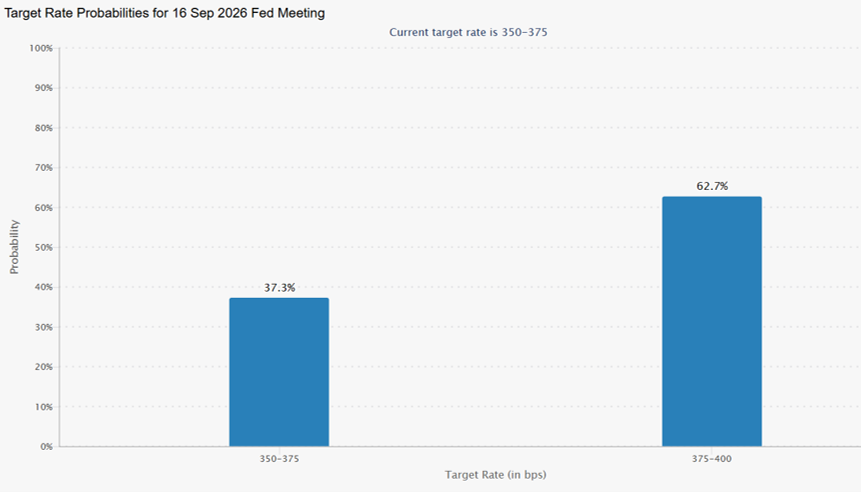 Source: CME Group
Crude Oil Prices Drop More Than 5% on Word of New Peace Negotiations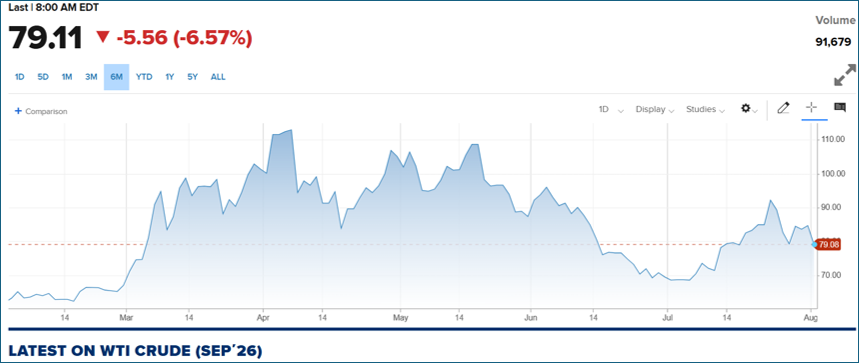 Source: CNBC
July Employment Gains Expected to Improve from a Weak June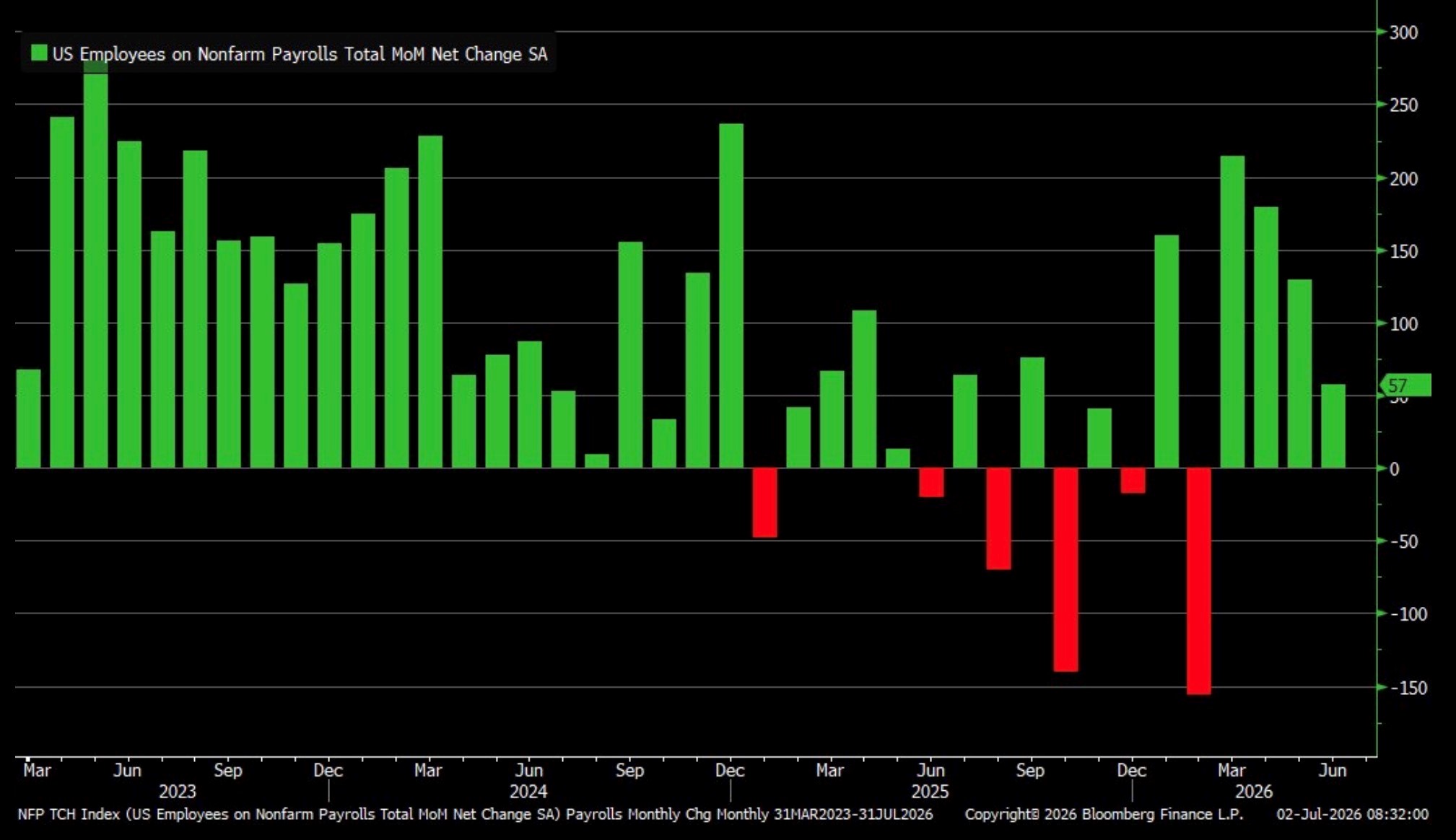
Source: BLS
July ISMs Expected to Improve Slightly from June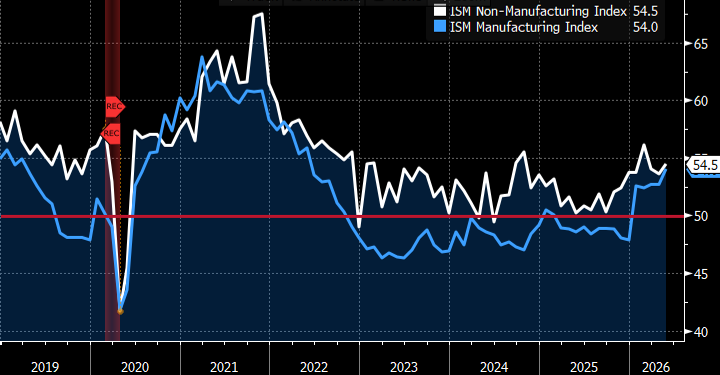 Source: Institute of Supply Management
Securities offered through the SouthState | DuncanWilliams 1) are not FDIC insured, 2) not guaranteed by any bank, and 3) may lose value including a possible loss of principal invested. SouthState | DuncanWilliams does not provide legal or tax advice. Recipients should consult with their own legal or tax professionals prior to making any decision with a legal or tax consequence. The information contained in the summary was obtained from various sources that SouthState | DuncanWilliams believes to be reliable, but we do not guarantee its accuracy or completeness. The information contained in the summary speaks only to the dates shown and is subject to change with notice. This summary is for informational purposes only and is not intended to provide a recommendation with respect to any security. In addition, this summary does not take into account the financial position or investment objectives of any specific investor. This is not an offer to sell or buy any securities product, nor should it be construed as investment advice or investment recommendations.


