
July CPI Hits Expectations but Above June’s Cooling Print

- The first of the July inflation data arrived this morning with CPI and the results are discussed in more detail below but suffice it to say it was close to expectations which means slightly warmer than the cool June print, but it reduced odds of a September hike to 42% vs. a toss-up which it was before the new price data. Keep in mind too the Fed will have August inflation and jobs numbers before the September rate decision on the 16th. Thus, plenty of data remains to be seen that will be key to a rate decision, so nothing will be definitive off this week’s reports. After the inflation data wraps up the week finishes with July Retail Sales providing a check on the health and wellbeing of the US consumer. Currently, the 10yr is yielding 4.66%, down 3bp, while the 2yr is yielding 4.17%, down 5bp on the day.
- Today’s July CPI was near expectations as an uptick in energy costs led to a small increase in headline inflation, up 0.1% for the month, as expected. Recall, in June overall inflation decreased -0.4%, with the YoY rate decreasing from 4.2% to 3.5%. The July YoY rate slid a tenth to 3.4%, which also matched expectations. Energy costs were down -1.5% for the month vs. -5.7% in June as the brief ceasefire in the Iran war faded away in July. The caveat here is CPI data is taken around mid-month, so it missed the second half uptick in gas prices as fighting resumed briefly in Iran. The Food category was docile, increasing 0.1% after two months at 0.2%. Thus, the spreading of higher energy costs that looked to be happening in March and April was harder to spot for a third month in a row.
- Core CPI increased 0.2% MoM (0.22% unrounded), matching expectations. That was an increase from the unchanged reading in June but a repeat of May’s result. The modest increase in the monthly rate led to the YoY rate decreasing from 2.6% to 2.5%, matching expectations.That’s the lowest core YoY reading since March 2021. Shelter costs rose just 0.1%, matching the June increase, which was the smallest since January 2021.
- Meanwhile, Owners’ Equivalent Rent (OER) rose 0.3%, up from the June 0.2% increase. Three out of the last four months have seen OER increase 0.3%MoM. Pre-pandemic, OER – the largest single CPI component – varied between 0.2% and 0.3%. Getting OER to consistently print closer to 0.2% remains on the Fed wish list. Also, the Fed will like that Core Services ex-Housing (Super Core) followed a June decrease of -0.21%, (the largest monthly drop since May 2020) with a modest 0.2% increase (0.189% unrounded), and compares to 0.27% in May and +0.45% in April (see graph below). The YoY rate dropped from 3.17% to 2.84%.
- Tomorrow brings us July PPI and combined with CPI will allow analysts to better estimate the PCE inflation numbers due at the end of the month. Headline Final Demand was up 0.2%, as expected vs. -0.3% in June but better than the 0.6% increase in May and 1.1% in April. The YoY rate is expected to decrease from 5.5% to 4.9%. Ex-food, energy, and trade the index is expected to increase 0.3% vs. 0.1% in June but much better than the 0.8% pace in May. The YoY rate is expected to fall from 5.1% to 4.6%. Despite this expected improvement the YoY rate will remain the highest since early 2023 when rates were retreating after peaking in late 2021/early 2022 at 7.0%.
- With the PPI report and its healthcare, airfare, and portfolio management costs, and secondarily next week’s Import/Export Price report, analysts will be able to provide a fairly accurate estimate of the Fed’s preferred inflation measure, PCE, due on August 26,and currently tracking at a benign 0.1% before this week’s new inflation data.
- Taking a longer-term macro view, the quest to return to 2% PCE inflation will be extremely challenging. The blockage from the Strait doesn’t look to be ending anytime soon. Add in the Houthi actions around the Red Sea and the free flow of ocean-going traffic is not close to what it was in February. The shortfall in energy and related products from the stalemate will continue to draw down related inventories and pressure prices. But shipping more broadly, of all types and locations, is also being stressed. That adds costs and, at the very least, friction to the global economy that is likely to get worse before it gets better. Add in the constant drumbeat of new tariff announcements which further increases pricing pressure. Thus, if the Fed is adamant about getting inflation back to 2% sooner rather than later it will require enough hikes that slow the global economy to better balance the current state of supply and demand. That will be more than a single hike or two.
July CPI YoY – Both Overall and Core as Expected at 3.4% and 2.5%, Respectively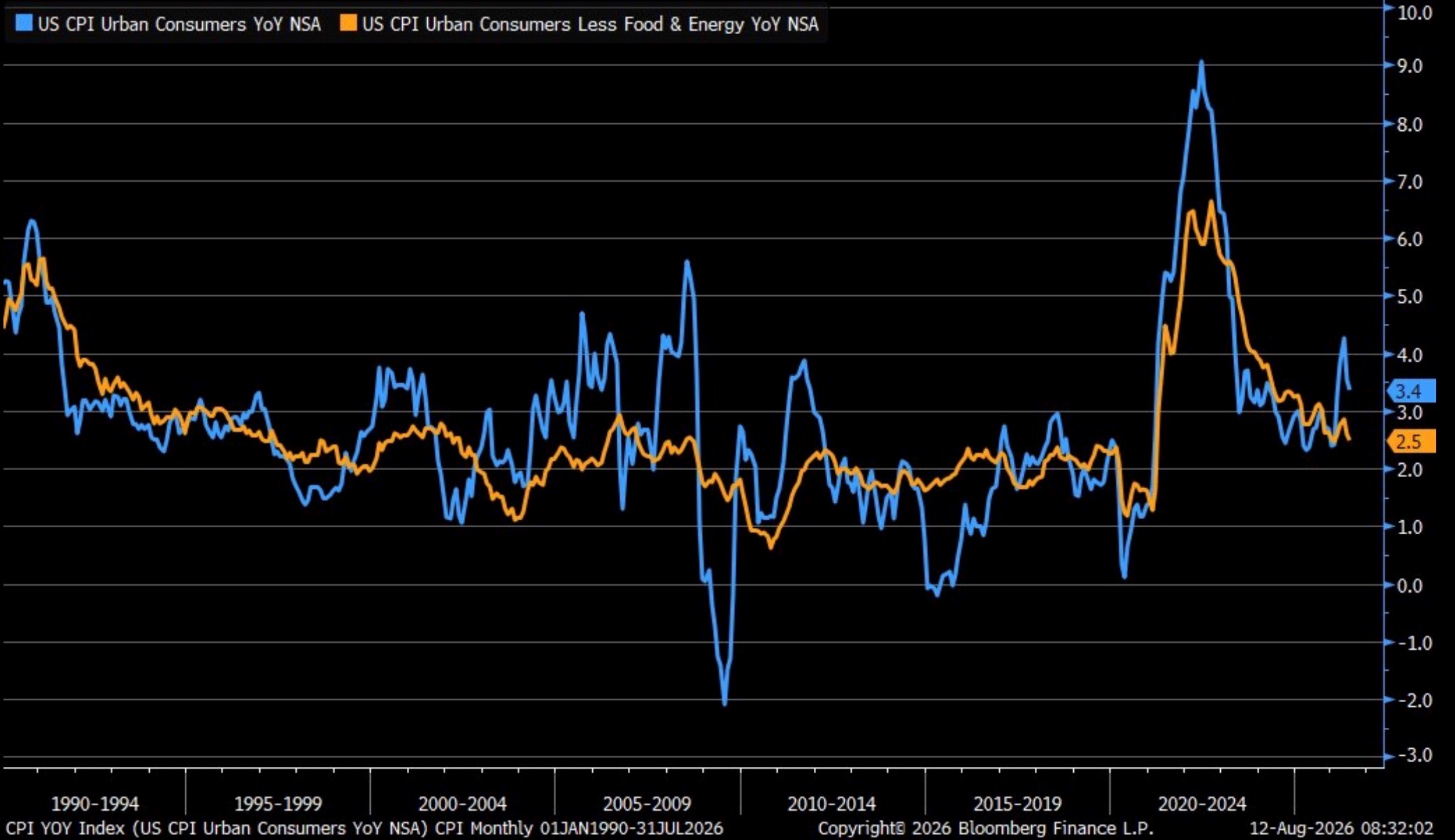 Source: BLS
Monthly Price Changes by Category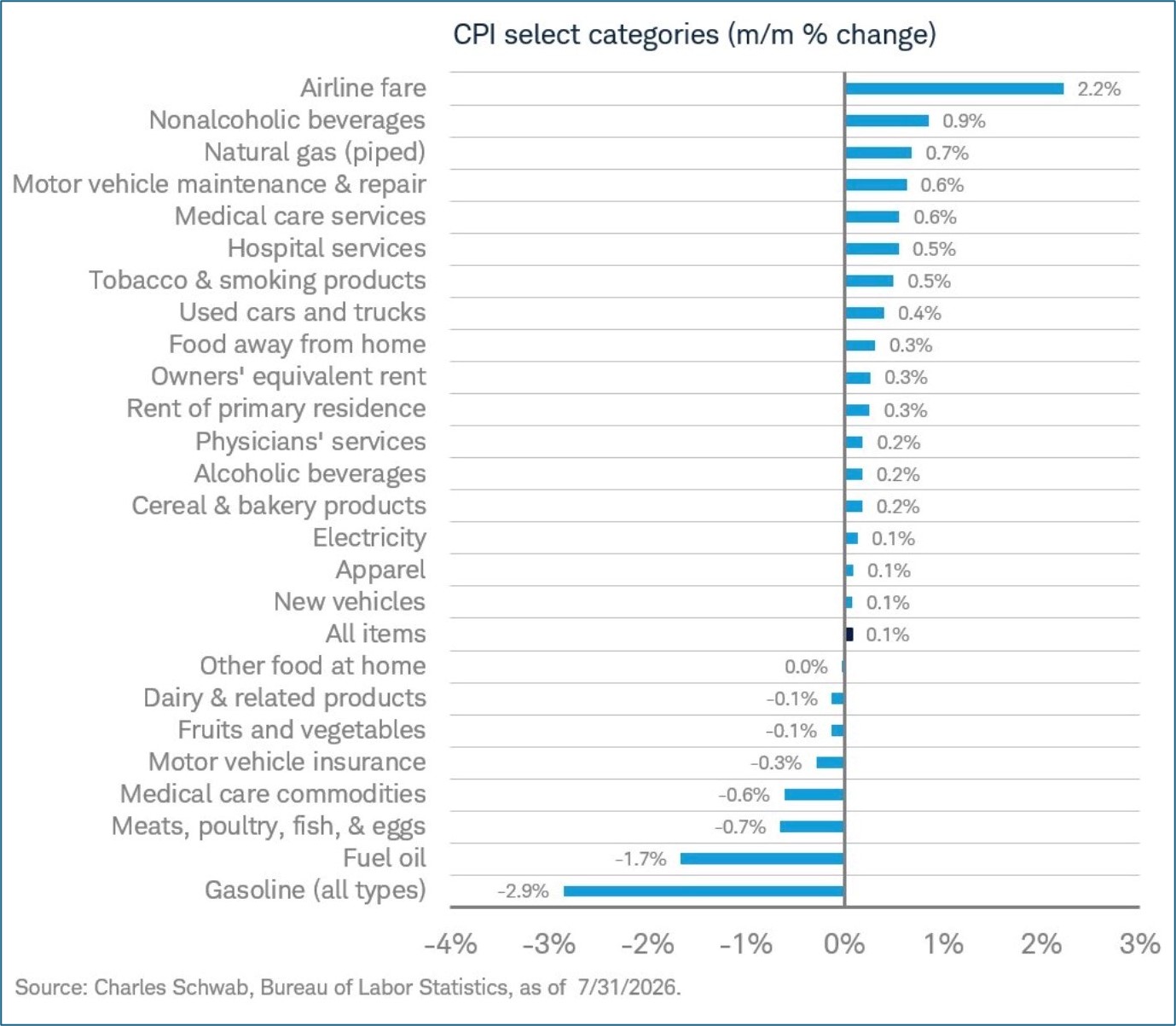
Core Services Ex-Housing Up +0.189% after -0.206% MoM drop in June – “Sticky” Inflation Remains Tame for Second Straight Month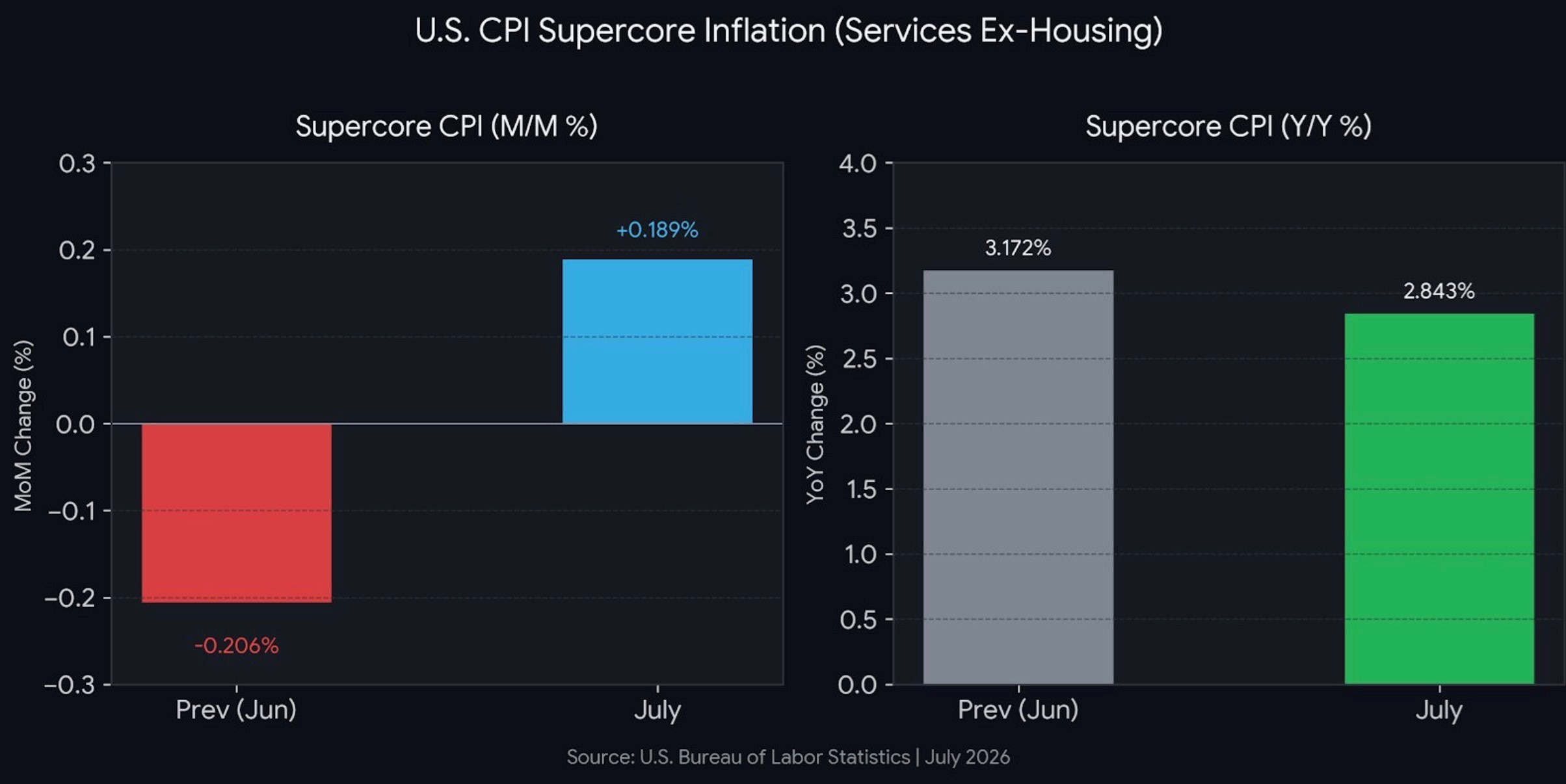 Source: BLS
Securities offered through the SouthState | DuncanWilliams 1) are not FDIC insured, 2) not guaranteed by any bank, and 3) may lose value including a possible loss of principal invested. SouthState | DuncanWilliams does not provide legal or tax advice. Recipients should consult with their own legal or tax professionals prior to making any decision with a legal or tax consequence. The information contained in the summary was obtained from various sources that SouthState | DuncanWilliams believes to be reliable, but we do not guarantee its accuracy or completeness. The information contained in the summary speaks only to the dates shown and is subject to change with notice. This summary is for informational purposes only and is not intended to provide a recommendation with respect to any security. In addition, this summary does not take into account the financial position or investment objectives of any specific investor. This is not an offer to sell or buy any securities product, nor should it be construed as investment advice or investment recommendations.


