
July Jobs Report Misses Expectations

- July nonfarm payrolls fell 23 thousand, missing the 83 thousand gain expected and below the 20 thousand gained in June (revised lower from an initial 57 thousand). Private sector jobs, however, rose 30k, same as in June. Two-month revisions subtracted a substantial 103 thousand jobs from previous estimates. Job gains were in the areas that we’ve come to expect, namely healthcare at +22k (but off the 12-month average gain of 36k), construction added 22k (perhaps data center construction here). However, leisure and hospitality saw a second straight month of losses. In June, the loss was -43k and July’s was -40k. Retail trade was off -19k after losing -4k in June. Government shed -53k jobs which could be a seasonal adjustment issue around summer and school calendars. After the seasonal short-term impact of World Cup hires, we are seeing some unwind from those one-off sources of demand.
- The Household Survey, as opposed to the Establishment survey that produces the headline job growth number, generates rate data like the unemployment rate, labor force participation rate, etc.. For July, it was another month with a declining labor force, this time decreasing 264 thousand (those employed and those not working but actively looking for employment) and a 178 thousand decrease in unemployed persons. The survey also reported an 87 thousand decrease in employed persons, that follows a -507k decline in June. So, a second straight weak showing in the Household Survey.
- That drop in the labor force led to the unemployment rate declining a tenth to 4.1% (4.09% unrounded vs. 4.19% in June), the lowest since January 2025, but it’s a decline for all the wrong reasons. The decrease in the labor force led to the Labor Force Participation Rate dropping to 61.4 vs. 61.5%. That’s the lowest rate since May 2020. Thus, the drop in the unemployment rate is less positive as it comes from people dropping out of the labor force and thus not counted as unemployed.
- Meanwhile, Average Hourly Earnings rose 0.1% MoM, below the 0.3% expectation, and the 0.3% June gain. The year-over-year pace decreased three-tenths to 3.2%, missing the 3.5% expectation and the June result. Average weekly hours remained unchanged at 34.3 hours, as expected. Bottom line, with annual wage gains in the low to mid 3% level and CPI inflation at 3.5%, real incomes are basically breakeven to slightly negative. Maintaining consumption gains in that environment will be a challenge.
- Bottom line: with the unexpected July job losses, and weakening in wage gains, the Fed can’t be assured that the labor market is on solid footing. That may limit its ability to combat inflation if these job numbers continue to weaken. Thus, this report has decreased odds of a hike in September to just 40%. They were over 60% prior to this report.
Finally, initial jobless and continuing claims continue with the low-fire theme while the jobs report maintains the low-hire theme. Initial claims for the week ending August 1 increased from 198 thousand to 199 thousand. The 4-week average decreased 4.5 thousand from 203.25 thousand to 198.75 thousand. Meanwhile, continuing claims for the week ending July 25 rose 24 thousand from 1.777 million to 1.801 million. As the graph below shows, however, little has changed between the two measures for months now as companies slow hiring but remain content to hang onto existing employees.
Healthcare Continues to Lead New Hires but Not Enough to Offset Weakness Elsewhere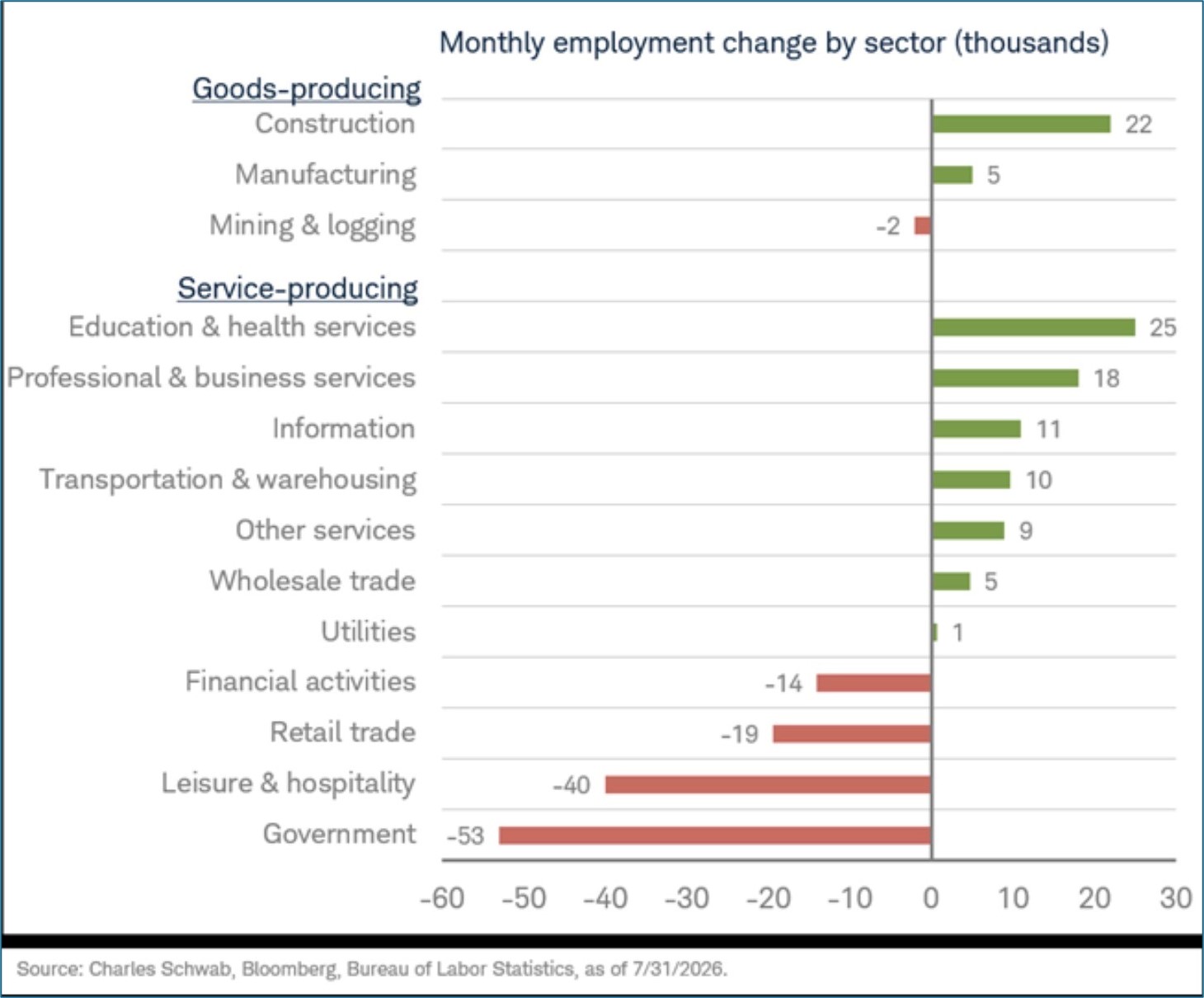 Source: BLS
Monthly Change in Nonfarm Payrolls – First Drop Since February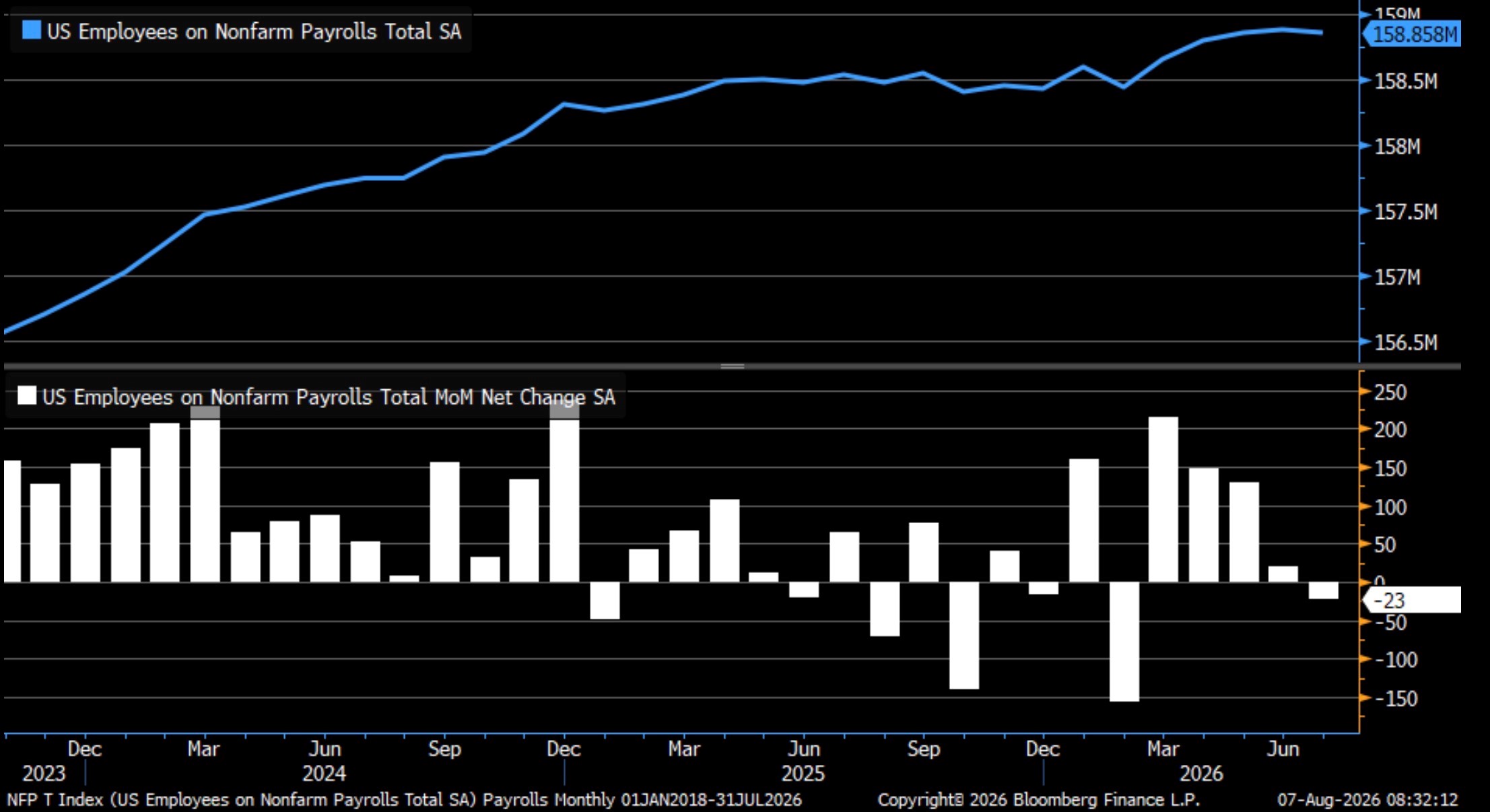 Source: BLS
Initial and Continuing Jobless Claims – Wash, Rince, Repeat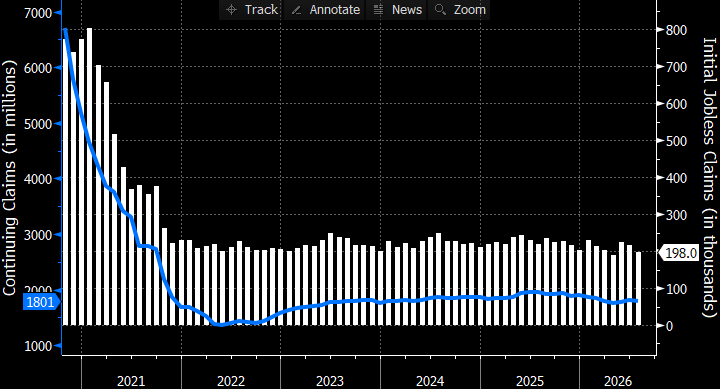 Source: Dept. of Labor
Securities offered through the SouthState | DuncanWilliams 1) are not FDIC insured, 2) not guaranteed by any bank, and 3) may lose value including a possible loss of principal invested. SouthState | DuncanWilliams does not provide legal or tax advice. Recipients should consult with their own legal or tax professionals prior to making any decision with a legal or tax consequence. The information contained in the summary was obtained from various sources that SouthState | DuncanWilliams believes to be reliable, but we do not guarantee its accuracy or completeness. The information contained in the summary speaks only to the dates shown and is subject to change with notice. This summary is for informational purposes only and is not intended to provide a recommendation with respect to any security. In addition, this summary does not take into account the financial position or investment objectives of any specific investor. This is not an offer to sell or buy any securities product, nor should it be construed as investment advice or investment recommendations.


