
June Jobs Report Misses Expectations, Yet Unemployment Rate Dips to 4.2%

- June nonfarm payrolls rose a disappointing 57 thousand, missing the 115 thousand expected and less than the 129 thousand gained in May (revised lower from an initial 172 thousand). Two-month revisions subtracted 74 thousand jobs from previous estimates. Thus, the May occurrence of an upward revision reverted in June to the more typical downward revisions of the last couple years. Also, the lackluster June gain and the downward revisions for April and May wipes out what was a three-month streak of 150 thousand or better gains. Job gains remained strong in areas that we’ve come to expect, namely healthcare with +47k, but Leisure and Hospitality, after a surprisingly strong +70k gain in May (World Cup hiring?) reverted to a loss of -61k. Also, another sector that contributed to the May strength, government jobs rose only 8k after originally gaining +52k in May (revised lower to 32k in today’s report). No doubt seasonal adjustment issues contributed to the upside May surprise, along with the one-off World Cup jobs, and that reversed in June.
- The Household Survey is smaller than the Establishment Survey and subject to more volatility, but it generates the important unemployment rate, labor force participation rate, etc.. For June, it was a decidedly more somber picture than the Establishment Survey. The Household Survey reported a large decrease of 720 thousand people in the labor force (those employed and those not working but actively looking for employment) and a 213 thousand decrease in unemployed persons. The survey also reported a 507 thousand drop in those employed. The unemployment rate dipped a tenth to 4.2% (4.19% unrounded vs. 4.30% in May), after three straight months at 4.3%. The decrease in the labor force led to a sizeable drop in the Labor Force Participation Rate to 61.5 vs. 61.8%. That’s the lowest rate since March 2021. Thus, the drop in the unemployment rate is less positive as it comes from people dropping out of the labor force and thus not counted as unemployed.
- Meanwhile, Average Hourly Earnings rose 0.3% MoM, matching expectations, and the May gain. The year-over-year pace increased one-tenth to 3.5%, also matching expectations. Average weekly hours remained unchanged at 34.3 hours, as expected. Bottom line, YoY wage gains seem to be leveling around 3.5% after peaking at 6.0% in 2022 and trending lower since. With annual wage gains in the mid 3% level, and inflation just over 4% real incomes are slightly negative and likely to remain that way in the second half of the year. Maintaining consumption gains in that environment will be a major challenge.
- Bottom line: with the soft June job growth, but stable wage gains, the Fed is assured that the labor market is not adding to inflationary pressures. That said, the soft hiring and drop in the labor force may become a concern if it’s repeated in subsequent reports. That would make a hiking decision much harder in the face of a softening labor market/economy. The energy price spike has already started to ease, but other non-energy sectors will likely be slow to retrace lower. That will keep the Fed on pause and waiting on lower prices for the next few months. Thus, this report will reduce odds of a hike in July and September, with the Fed inclined to wait on better inflation numbers and hope the weaknesses noted in this report don’t worsen in coming months.
- Finally, initial jobless and continuing claims continue with the low-fire theme while the jobs report maintains the low-hire theme. Initial claims for the week ending June 27 decreased from 216 thousand to 215 thousand. The 4-week average decreased from 224.50 thousand to 222.00 thousand. Meanwhile, continuing claims for the week ending June 20 rose from 1.812 million to 1.814 million. As the graph below shows, however, little has changed between the two measures for months now as companies have slowed hiring but remain content to hang onto employees.
Healthcare Continues to Dominate New Hires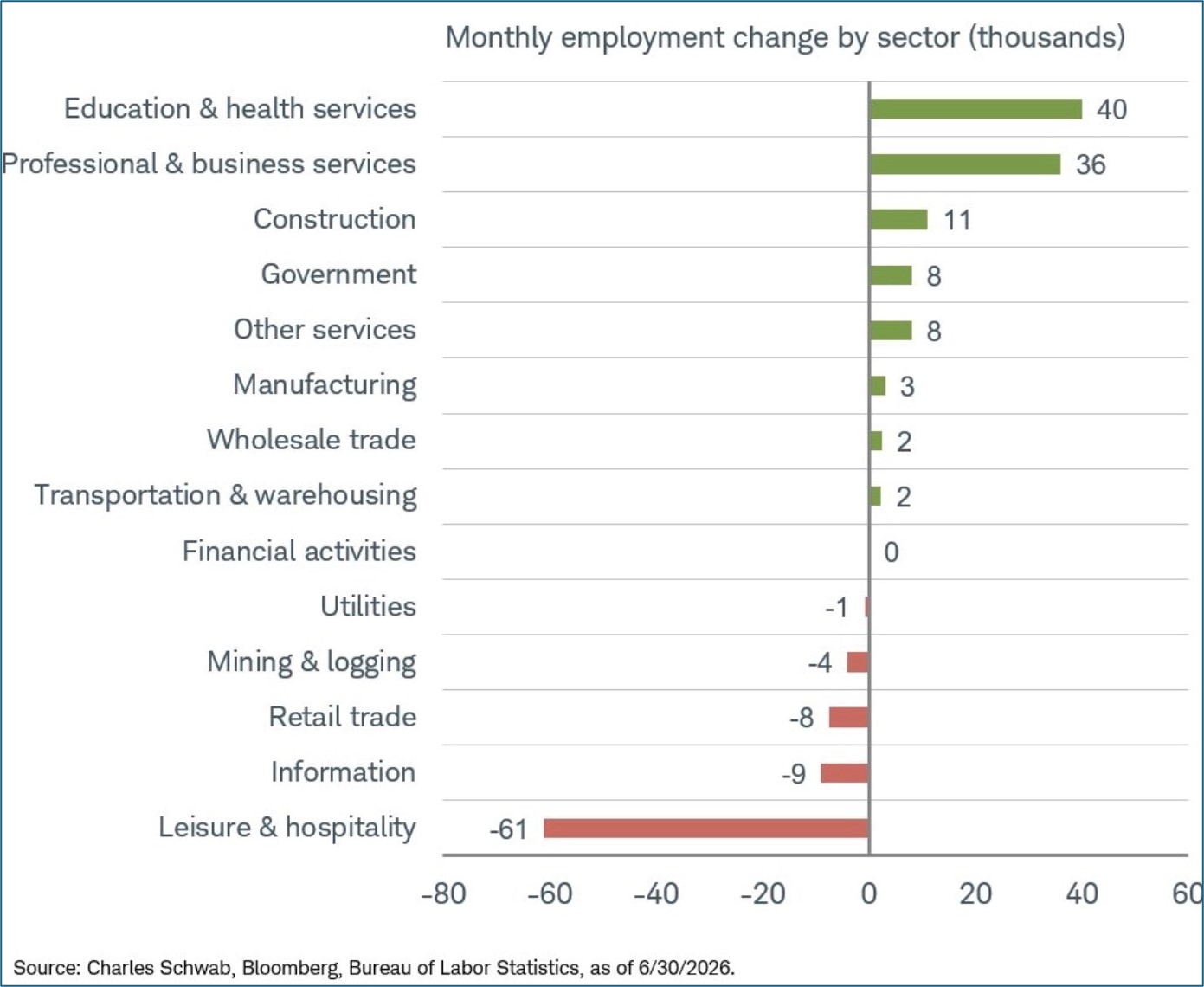 Source: BLS
Monthly Change in Nonfarm Payrolls – A Softer Picture Emerges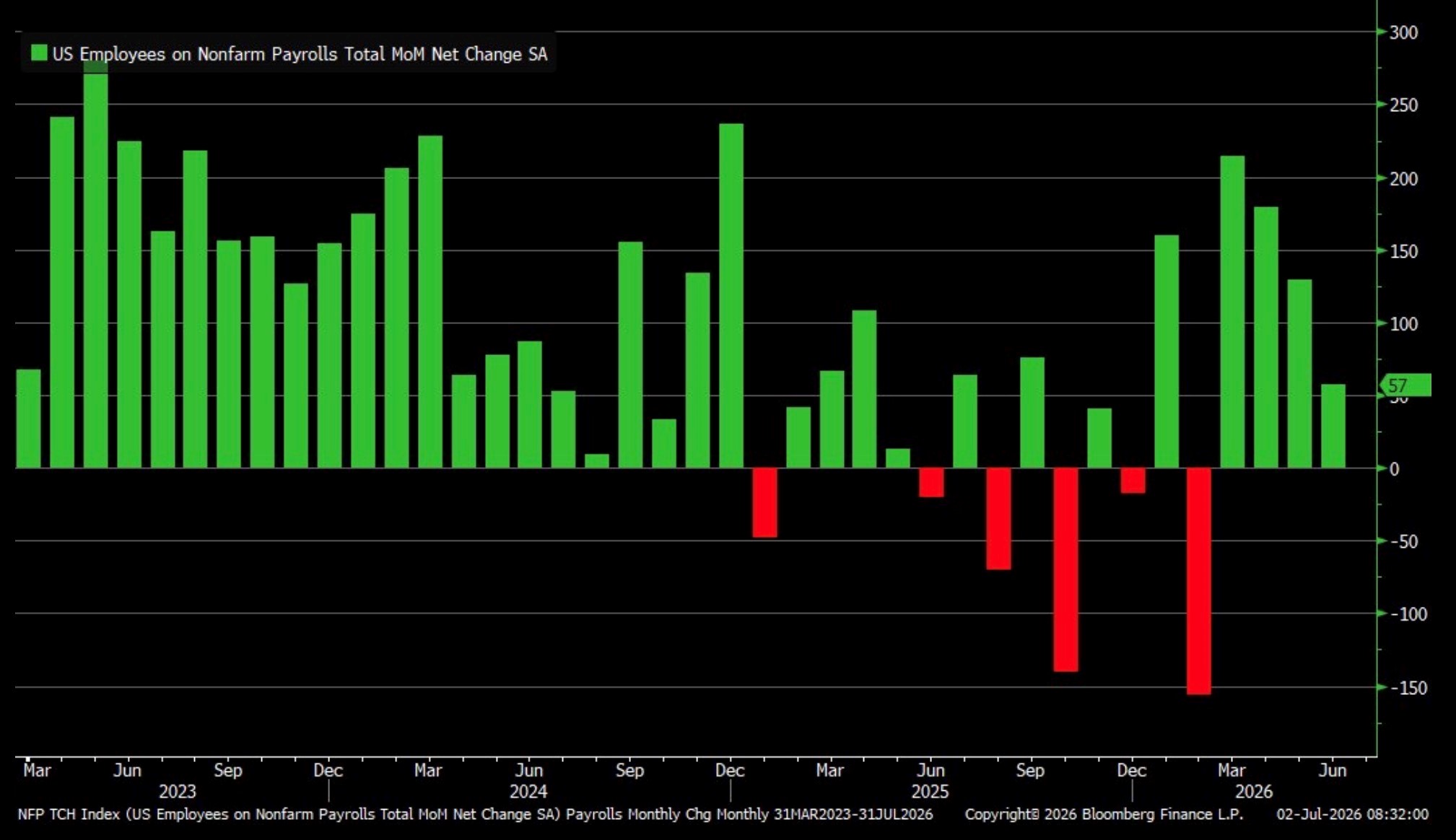
Source: BLS
Initial and Continuing Jobless Claims – Both Continue to Reflect the Low-Fire Environment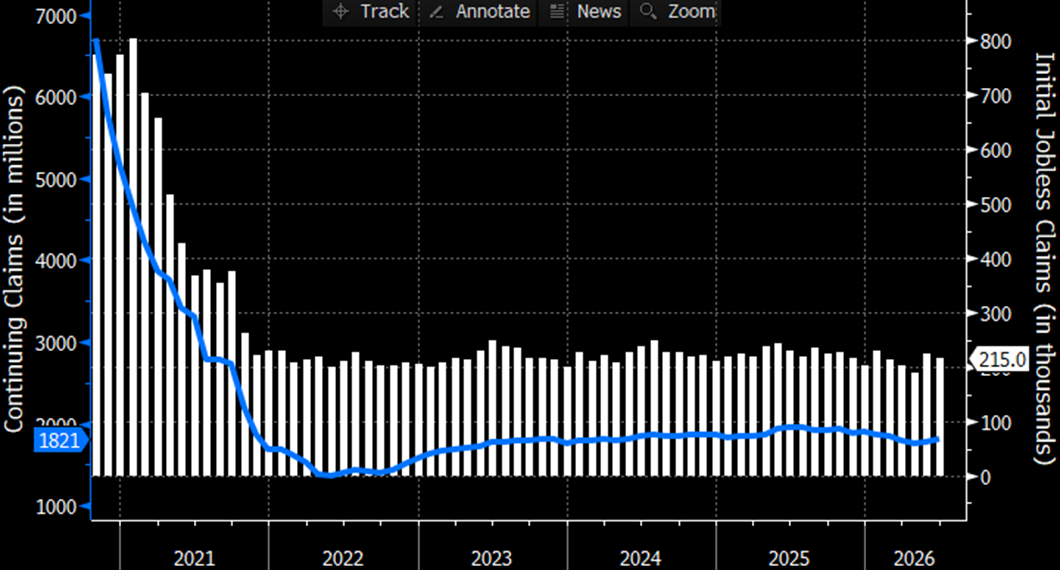
Source: US Dept. of Labor
Securities offered through the SouthState | DuncanWilliams 1) are not FDIC insured, 2) not guaranteed by any bank, and 3) may lose value including a possible loss of principal invested. SouthState | DuncanWilliams does not provide legal or tax advice. Recipients should consult with their own legal or tax professionals prior to making any decision with a legal or tax consequence. The information contained in the summary was obtained from various sources that SouthState | DuncanWilliams believes to be reliable, but we do not guarantee its accuracy or completeness. The information contained in the summary speaks only to the dates shown and is subject to change with notice. This summary is for informational purposes only and is not intended to provide a recommendation with respect to any security. In addition, this summary does not take into account the financial position or investment objectives of any specific investor. This is not an offer to sell or buy any securities product, nor should it be construed as investment advice or investment recommendations.


