
Retail Sales and Nvidia Chips in China

- The beatings are continuing in the AI space, and morale is not improving. We say the “AI space” but the selling has spread into non-tech sectors as the post-Huang fallout continues to deepen. Speaking of Nvidia, they reported quarterly results after yesterday’s close and beat on both the top and bottom lines, but investor reactions were like, “these were Jensen’s numbers. What comes next?” Well, we’re about to find out. Meanwhile, we didn’t see much weakness either in October Retail Sales, but the suddenly tentative market is looking harder for signs of a coming downturn. The one area that unequivocally is driving the economy, the AI buildout, continues and continues to pressure prices as the latest Import Price report revealed yesterday (more on that below). Relatedly, the Trump administration tightened restrictions on China’s access to advanced AI computing by requiring export licenses for high-end AI chips shipped to major third-country data-center hubs, including Singapore, Malaysia, Thailand, Indonesia, and Brazil. This move was in response to news that Commerce Secretary Howard Lutnick was looking the other way and allowing some of Nvidia’s most highly prized chips to be sold in China. Finishing with more mundane items, the latest Fed speak has it that four more hikes (including December) may be necessary. Currently, the 10yr is yielding 5.12%, up 1bp, while the 2yr is yielding 4.83%, up 4bp on the day.
- Fed speak is active this week with four speakers today and the FOMC minutes from the October meeting due at 2pm ET. Fed Governor Chris Waller spoke on CNBC this morning and said the Fed “may need to shock the market with a 50bp hike.” He went on to say if not 50bp, then make it clear that a December hike of 25bp will be repeated in January. That, of course, conflicts with Fed Chair Warsh’s antipathy towards forward guidance. Yesterday, St. Louis Fed President Albert Musalem (non-2026 voter) did speak on policy and said he expects “several” rate hikes by the end of spring. Most Fed Speak dictionaries denote “several” as meaning 4 to 6 (generally in regard to the number of participants expressing an opinion in FOMC minutes). Taking the low end of that range of four potential hikes would put the rate at 4.75% – 5.00%. That’s at the upper end of most terminal estimates but it does mark the first time a Fed member has “gone there” with a policy estimate, but with some customary vagueness. Today brings another four speakers so be on the lookout for more tape bombs to interrupt your day as we’ve already seen this morning from Waller.
- Yesterday, the most anticipated report of the week, October Retail Sales, brought back the most proof of the ongoing equity volatility, and if you were looking for some hints of consumer softness from the ongoing equity volatility it wasn’t really found in the report. Overall sales increased 0.2% MoM vs. 0.1% expected and 0.8% the prior month. If you had to find a trouble spot it would be the slowdown in big-ticket purchases, with motor vehicles sales falling 1.6% and furniture and home furnishings dropping 2.3%, but in other respects it was a solid showing. Core Sales (called the Control Group and is like the Personal Consumption figures in GDP) climbed 0.6% vs. 0.3% expected and 0.5% prior. It’s that figure that speaks to another solid month of spending by the consumer.
- The penultimate October inflation release arrived yesterday with the October Import/Export Price report. The bottom line on this report is that the fingerprints of AI are all over it and driving the bulk of price increases. The Import Price Index increased 1.1% vs. 0.7% forecasted and identical to September’s 1.1%. Ex-petroleum, import prices rose 0.8% vs. 0.4% expected and 0.5% in September. A couple points: first, the line item that is used in PCE inflation calculations, foreign airfares, rose 3.7% vs. 12.6% in September. While still a stout gain, it didn’t come close to matching the prior month so it’s not likely to push the Core PCE estimate significantly higher than its current 0.29% level. Second, price increases were heavy in the Finished Capital Goods category which includes AI-related products like computers, peripherals, and semiconductors. The monthly increase was 1.5%, the largest monthly gain in this line item that dates back to 1988. Monthly price gains by country were as follows: China (+1.4%, largest monthly gain since the 2004 inception of this line item), Japan (+0.3%), Mexico (+0.2%), Canada (1.6%, the largest increase since May 2026) and the EU (0.2%).
- A couple caveats on this report, first, it’s not inflation-adjusted so the monthly totals are impacted by price changes that can mask underlying activity. For October, drops in gas prices led to the headline figures falling short of prior month totals but the Control Group sales were a beat and matched a solid September. Second, October is a particularly difficult month to ascertain trends, sandwiched between the back-to-school season and just before the year-end holiday season it can generate as much noise as it does signal. Thus, don’t read too much into this month other than the lack of softness illustrates the ongoing resilience of the US consumer.
- In another example of ongoing labor market resilience, the Weekly ADP Pulse Report found 23,750 new private sector jobs for the week ending October 31 (actually a four-week average) and is the highest weekly gain in over a month. That weekly total implies a monthly figure close to 100,000 and would be in line if not a bit stronger than recent monthly payroll reports. Thus, while the inflation battle seems far from won, the Fed at least enjoys a stable labor market that allows them to focus on that 2% inflation target.
- Speaking of stable labor markets, but with a troubling trend, the Philly Fed recently published an analysis of the breakeven estimate for employment necessary to maintain a stable unemployment rate and it’s near 20-35 thousand new jobs per month. The paper also mentioned that estimate could move lower given the slowing in both domestic population growth and immigration. The trend in those two metrics has been down and if that continues the breakeven estimate will move lower as well. This is reminiscent of Japan a couple decades earlier and it contributed to the stagnant period of economic growth in that country. So, while giving the Fed room to maneuver on its inflation mandate, there are signs that future economic growth rates may struggle.
Odds for a January Hike of 25bp Over 73%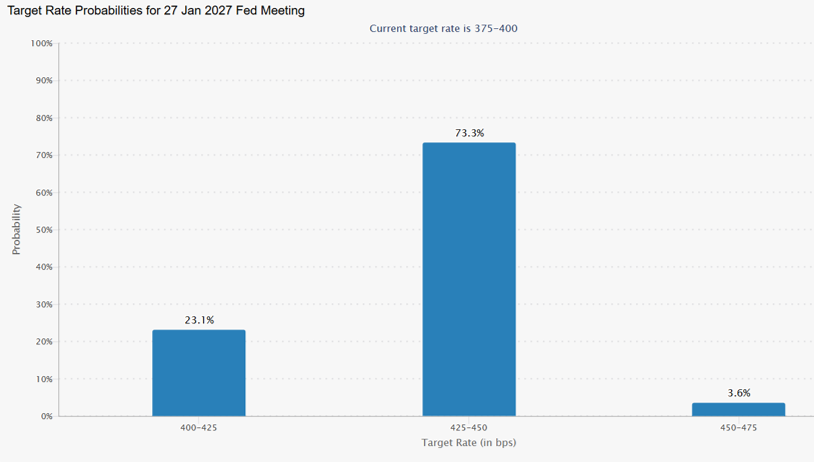 Source: CME Group
October Retail Sales Monthly Change by Category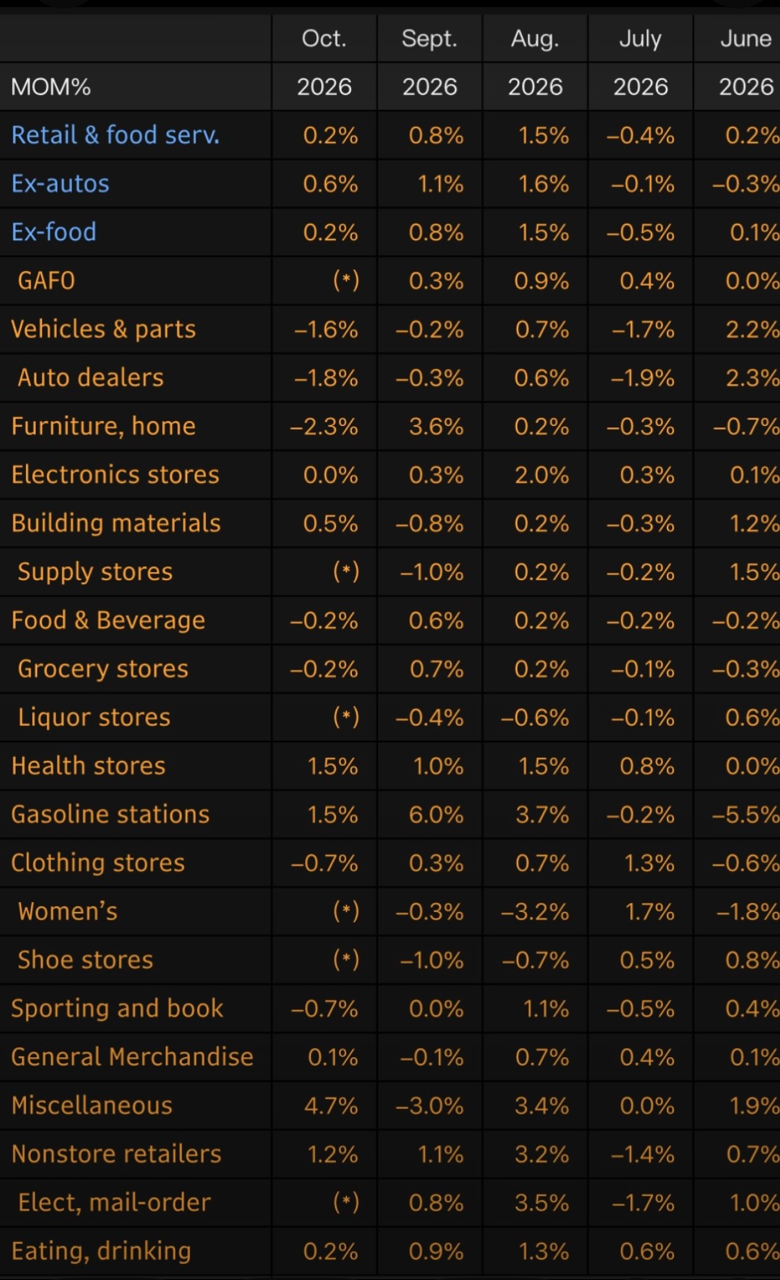 Source: US Census Bureau
October Import Prices Change – Capital Goods – Can you Spot the AI Impact?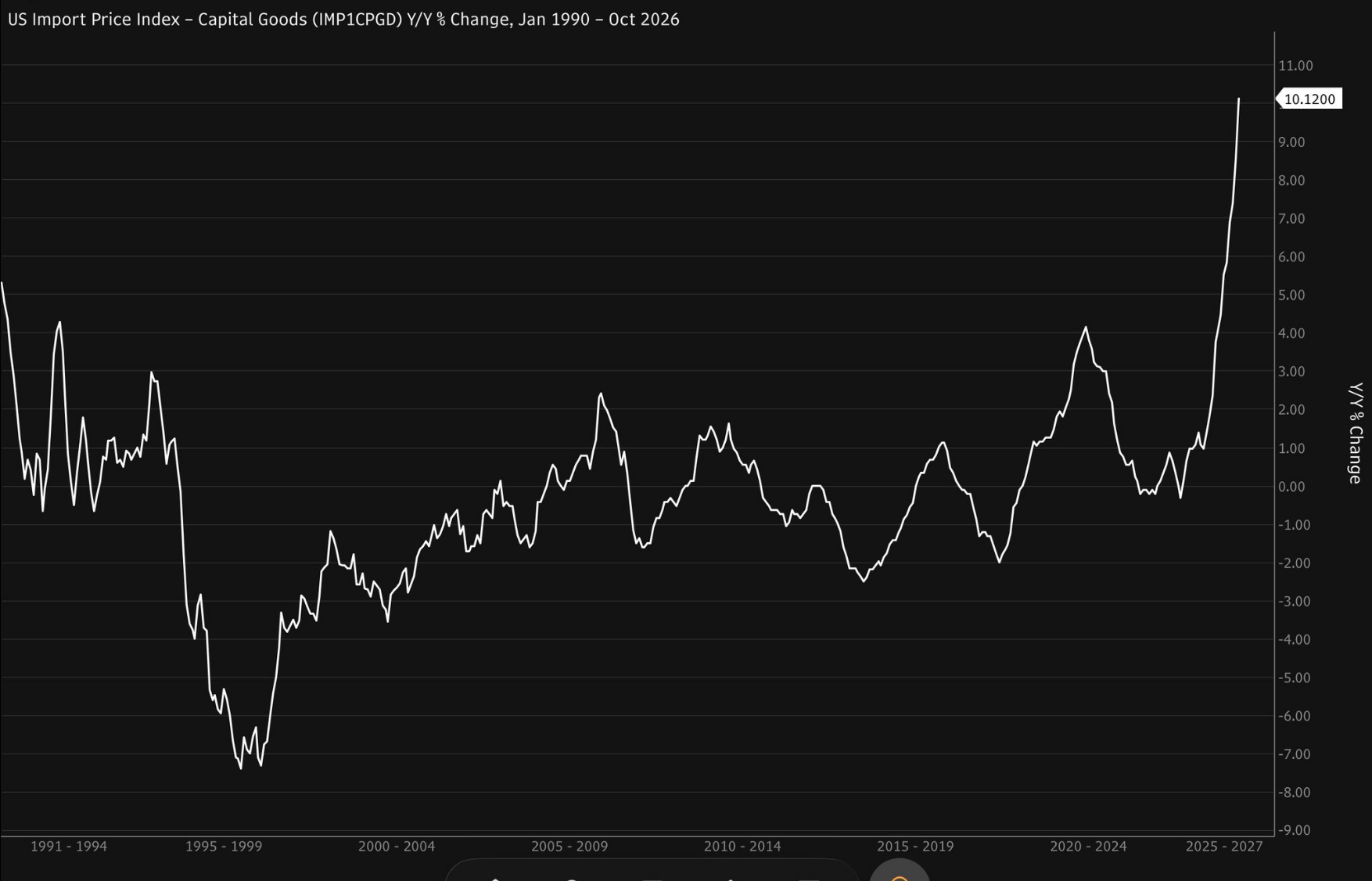 Source: US Census Bureau
Securities offered through the SouthState | DuncanWilliams 1) are not FDIC insured, 2) not guaranteed by any bank, and 3) may lose value including a possible loss of principal invested. SouthState | DuncanWilliams does not provide legal or tax advice. Recipients should consult with their own legal or tax professionals prior to making any decision with a legal or tax consequence. The information contained in the summary was obtained from various sources that SouthState | DuncanWilliams believes to be reliable, but we do not guarantee its accuracy or completeness. The information contained in the summary speaks only to the dates shown and is subject to change with notice. This summary is for informational purposes only and is not intended to provide a recommendation with respect to any security. In addition, this summary does not take into account the financial position or investment objectives of any specific investor. This is not an offer to sell or buy any securities product, nor should it be construed as investment advice or investment recommendations.


