
So, the Fed Hiked. Expect a Few More

- With the Fed meeting behind us, and the commencement of a tightening cycle after three years of stable to declining funds rates, investors are right to ask, “How many more?” We attempt to answer that question, as murky as the future may be, below. Now that the big September events have happened, there aren’t many potential catalysts over the next couple weeks from an economic calendar perspective. The remaining highlight for the month will be the August PCE inflation numbers due on September 30. The big unknown is whether core PCE prints at 0.2% MoM or tips into the 0.3% range. If that happens it will increase odds for an October hike, which currently stands at 55%. We discuss some of why we think they wait until December, but hedge that bet on the PCE outcome. Currently, the 10yr is yielding 4.97%, up 2bp, while the 2yr is yielding 4.72%, up 3bp on the day.
- As we know by now, the FOMC followed the consensus expectation by hiking 25bp and projected, via the Dot Plot, another hike by year-end. The 2027 year-end median dot reflects no change from 2026, but that doesn’t necessarily mean the Fed expects to be on hold for all of 2027. They could hike early in the year and take it back in the second half. That’s obviously projecting too much precision in a very imprecise exercise, but the point is just because the dots are unchanged from 2026 to 2027, don’t expect the Fed to be on hold throughout 2027. In 2028, however, they project an easing cycle to commence, albeit tentatively with the median dot falling 25bp from 4.125% to 3.875%.
- A couple of things stood out to us from the decision and Warsh press conference that were a bit unexpected. (1) It was a unanimous vote. After pausing in July with three dissents seeking a rate hike, we expected one or two dovish dissents from Wednesday’s hike. That implies it wasn’t a close call and that Warsh has managed to corral the committee into aligning with his hawkish bias. (2) Warsh commented that they were simply “removing some accommodation” with the hike. That implies there are more hikes to come before reaching neutral, much less getting into restrictive territory. Despite waving off a question on where he believes the neutral rate resides as “an academic exercise”, he obviously has a neutral rate in mind and it’s above the 3.25% median Longer-Term dot, and that was increased from 3.06% prior.
- As I sit here today, my guess is that four hikes will constitute the hiking cycle with the terminal range at 4.50% – 4.75%. Our rationale for that is the following:
-
- As of July, PCE sits at 3.7% and core PCE at 3.3%. That’s a long way from 2.0%. August PCE will be released on Sept. 30, but the monthly figures rolling off over the next several months are around0.2%, especially core, and that will limit improvement in the YoY rate unless we’re replacing 2025 prints with 0.0% and 0.1% MoM, and that seems a stretch in the current price environment.
- The 2yr Treasury yield around 4.70%-ish implies a similar terminal landing spot for funds.
- Many companies have likely resisted raising prices in the hopes that the energy shock and supply constraints would ease, but that hasn’t been the case. Look at the Food category in the latest CPI release. It increased 0.1% MoM and 2.7% YoY. That’s not bad for a category that is 14% of CPI. In a recent investor call, however, Campbell Soup’s CEO mentioned that they’ve exhausted the other avenues of cost containment from payroll/headcount management, pushing suppliers, and finally accepting some profit margin compression. Price hikes are the next logical step.
- One has to suspect there are plenty of companies that have resisted price increases but with the energy and supply shock continuing, and the consumer and economy holding up, price hikes seem to be looming on the horizon which implies a stickiness to inflation in addition to the tough comps from last year’s fourth quarter.
- With the solid August payrolls report and retail sales, the labor market and the consumer seem to not only be holding up well but gathering a second wind. Add in the ongoing capex spending on AI and the economy seems to have the resilience at present to withstand higher rates before slowing. That implies more than a hike or two to moderate that momentum and consumption.
- The good news from this projection is that longer-end bonds should hold up well in this environment with the Fed in a tightening cycle that is likely to slow both inflation and economic growth.
- With the FOMC meeting done and dusted, the remaining September calendar is thin on first-tier reports save the Personal Income and Spending release with its PCE inflation series. Fed speak will be hot and heavy with seven to eight Fed members scheduled to speak over the next week, not to mention those that find a mic on an ad hoc basis. Those headlines and developments from the Middle East situation will likely drive the trading environment over the next couple weeks into quarter-end.
- Finally, in another example of ongoing labor market resilience, the Weekly Initial Jobless Claims surprised on the downside at an eight-week low of 196 thousand for the week ending September 12. That low reading also coincides with nonfarm payroll survey week for the September jobs report (that’s one indicator that the payroll print will be decent to solid). The latest claims figure was 11 thousand lower than the 207 thousand expectation and down from the prior week’s 206 thousand. The four-week moving average dipped again to 203.25 thousand from 206.00 thousand prior, a five-week low. Continuing Claims also fell, this time, to 1.730 million for the week ending September 5th vs. 1.779 million consensus and 1.769 thousand the prior week (revised down from 1.774 million). The continuing claims print was the lowest since January 2024. So, there is no change in the low-fire environment.
Odds for Hikes at Oct. FOMC Meeting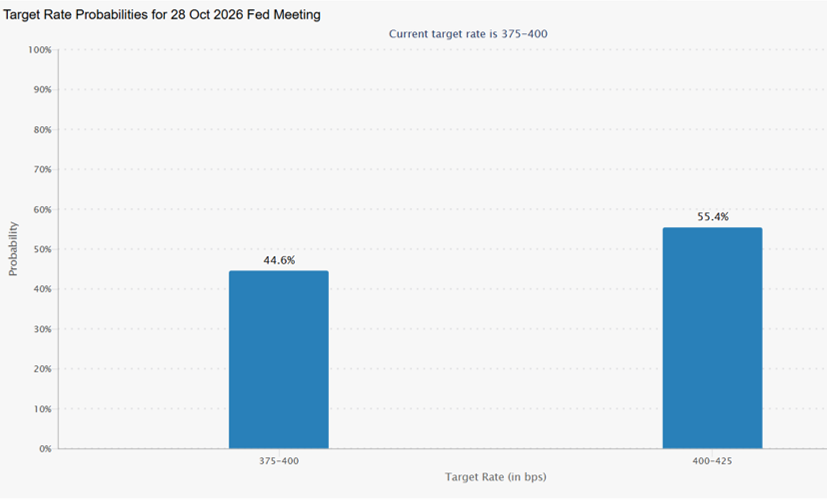 Source: CME Group
The Fed Sees One More Hike This Year, Steady in 2027, and Cutting in 2028 and 2029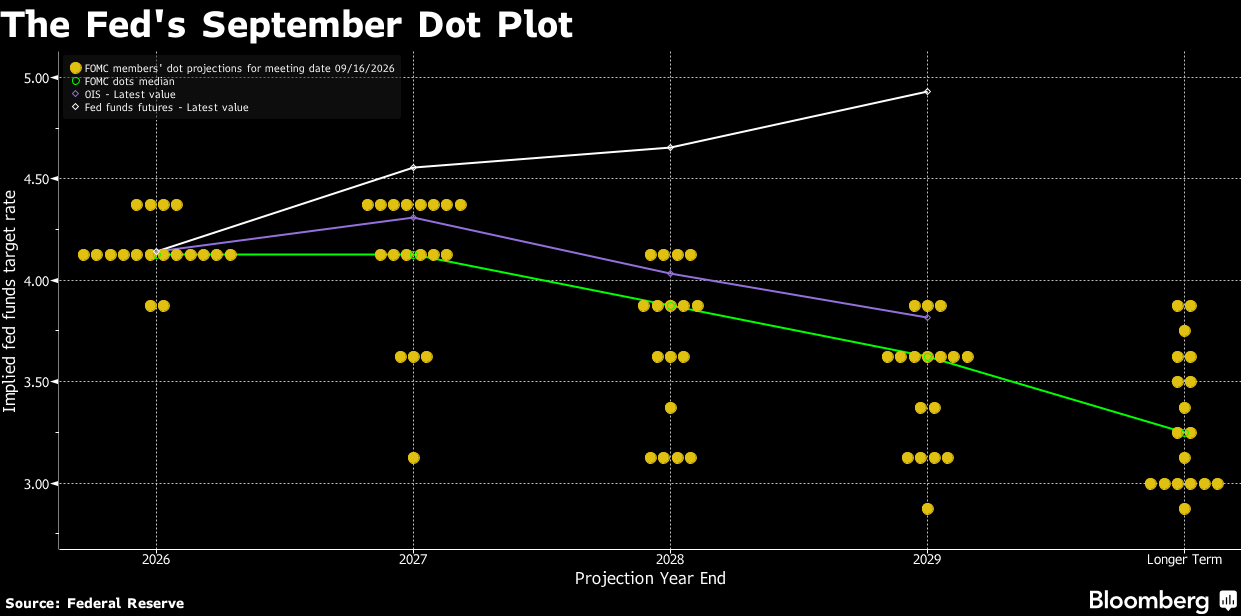 Source: FOMC
Initial and Continuing Jobless Claims – Decreases Yet Again as Low-Fire Environment Continues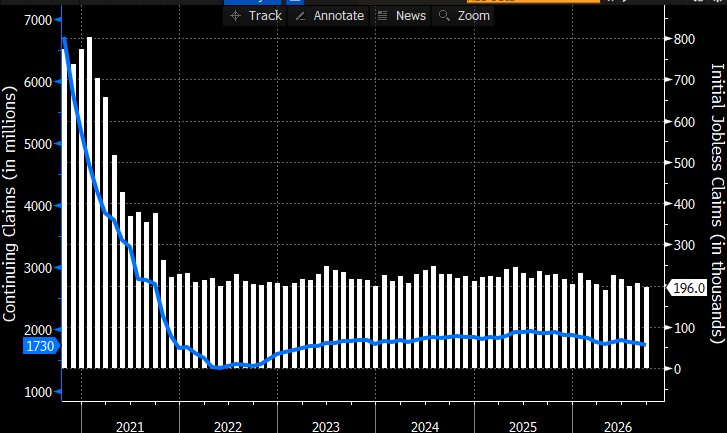 Source: US Dept. of Labor
Securities offered through the SouthState | DuncanWilliams 1) are not FDIC insured, 2) not guaranteed by any bank, and 3) may lose value including a possible loss of principal invested. SouthState | DuncanWilliams does not provide legal or tax advice. Recipients should consult with their own legal or tax professionals prior to making any decision with a legal or tax consequence. The information contained in the summary was obtained from various sources that SouthState | DuncanWilliams believes to be reliable, but we do not guarantee its accuracy or completeness. The information contained in the summary speaks only to the dates shown and is subject to change with notice. This summary is for informational purposes only and is not intended to provide a recommendation with respect to any security. In addition, this summary does not take into account the financial position or investment objectives of any specific investor. This is not an offer to sell or buy any securities product, nor should it be construed as investment advice or investment recommendations.


