
Thanksgiving Week Arrives with All Eyes on Equities

- The holiday-shortened week arrives with a limited economic calendar, which is all the better as investor attention will be squarely on equities. The question is will the risk-off trade that accelerated into overdrive last week continue over the next three trading days? Futures markets point to a bounce this morning (Nasdaq +3.5%), but the question is, “will it hold?” Obviously having equities enter correction territory complicates the Fed’s battle with inflation. The financial tightening that comes because of an equity drawdown won’t likely be enough to derail a December rate hike, but it may slow the next hike if the selling continues. Right now, January hiking odds have moved from over 70% following the release of the October FOMC minutes to 59% this morning. Essentially, it’s little more than a coin flip when a few days earlier, and many Nasdaq points ago, it seemed a much surer bet. In the meantime, the highlight for this week will be the equity action, of course, and October PCE inflation figures due on Wednesday. Until then, the S&P Global Preliminary November PMI series will be released today at 10am ET. Given the accelerating nature of the risk-off trade, these early reads on November activity may already be a bit stale. Currently, the 10yr is yielding 4.94%, up 3bp, while the 2yr is yielding 4.67%, up 5bp on the day.
- One of the more important of the meager releases this week comes at 9:45 am ET with the preliminary S&P Global PMI numbers for November. The October Manufacturing PMI printed at 54.9, Services at 56.1, and Composite at 55.9. With 50 being the dividing line between a contracting and expanding sector the October results were well into expansionary territory but off a few points from September. The expectation for November is for continued expansionary readings, but with slightly less strength than in the last two months. Keep in mind too, the data won’t capture the latest equity selling so you may want to mentally adjust the results down a few points when they arrive.
- The final November sentiment reading from the University of Michigan came late Friday morning and improved from the dour October readings. The headline sentiment index registered a 3.5-point increase from October (51.5 vs. 48.0) while the current conditions index rose nearly 3-points (49.4 vs. 46.7). The expectations index improved by 4-points (52.9 vs. 48.8). The improved sentiment was led by substantial post-election gains in both short- and long-run expected business conditions. Current personal finances improved for low-wealth consumers and, to a lesser extent, middle-wealth consumers, who experienced some relief with falling gas prices. In contrast, those with the largest stockholdings reported a decline in personal finances, consistent with continued AI-related equity selling as investors increasingly questioned valuations in the sector along with potential tightening in funding availability and cost.
- The expectations index surged for independents, who swung to the left in the midterms, and increased more moderately for Democrats. Expectations fell for Republicans, who may not favor a White House policy agenda that now faces a Democratic Congress. Rewinding back to February, sentiment remains 9% below levels prior to the Iran conflict, reflecting continued concerns regarding affordability that dominate consumers’ perspectives. Interviews for the survey were completed between October 20th and November 16th.
- Year-ahead inflation expectations fell from 4.7% to 3.7%; however, the current reading still exceeds the 3.4% seen in February before the Iran conflict began, along with all 2025 readings. Still, the expectation has narrowed by 100bps in one month and that is notable. Long-run inflation expectations took a smaller step lower from 3.5% to 3.3%. As in the year ahead expectations the long-run view remains higher than its 2024 range of 2.8% to 3.2%. Despite the softening in inflation expectations, consumers continue to report overwhelmingly that inflation—rather than unemployment—will cause greater hardship in the next one or two years.
- In a case of dueling sentiment surveys, tomorrow brings the Conference Board’s latest read on consumer confidence. The November release is expected to improve slightly from 91.7 to 92.1. Given the better-than-expected Univ. of Michigan results we’ll be interested to see if the Conference Board survey encounters the same findings, but of course all these measures must be taken with a note of caution give the subsequent equity sell-off.
- On Wednesday, the October Personal Income and Spending numbers with the PCE inflation series are due. Expectations for PCE are 0.3% MoM and 3.8% YoY and core PCE up 0.3% MoM and 3.2% YoY. The YoY numbers are both expected higher by a tenth to two-tenths vs. September and if they come as advertised, they will probably seal the deal on a 25bps hike in December with futures at 97% for said hike.
Odds at 59% for Rate Hike in January Following an Expected Hike in December 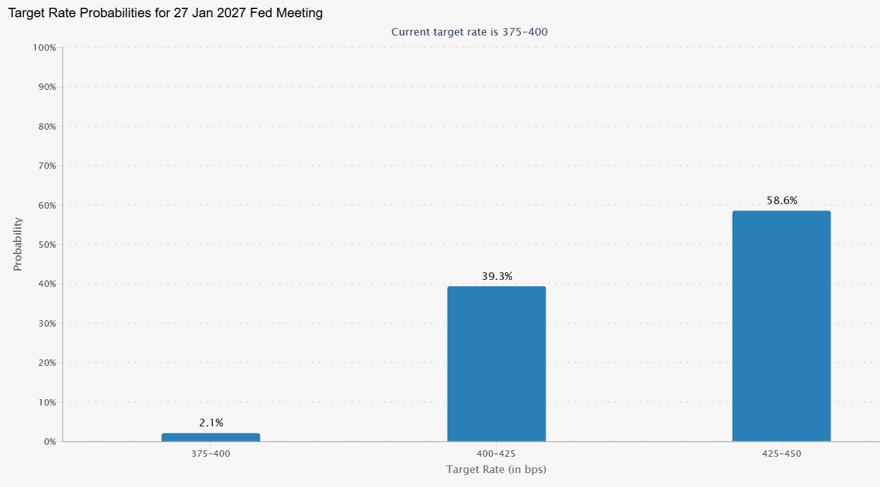 Source: CME Group
Inflation Expectations also Improve Post-Election but Remain above Pre-War Levels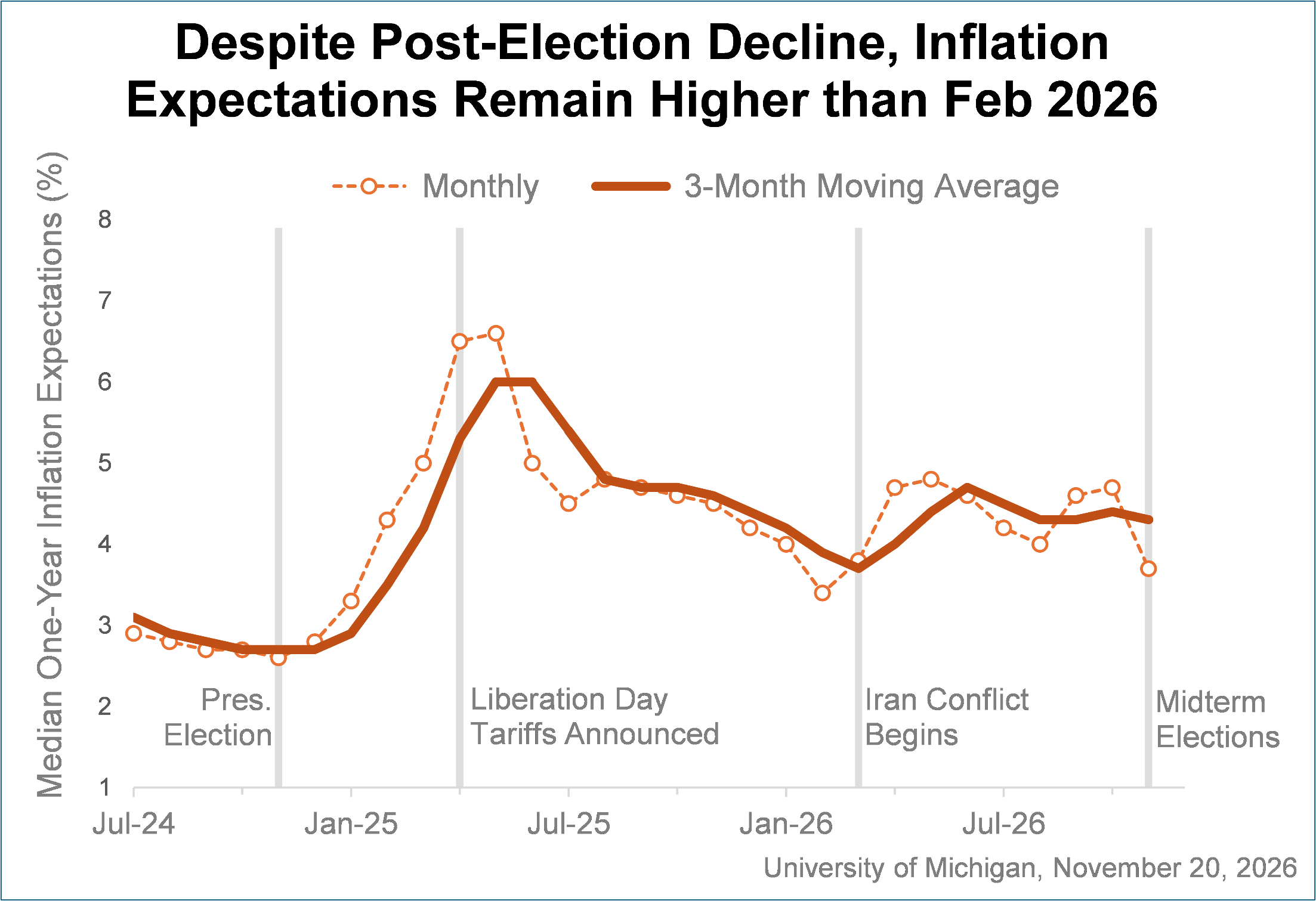 Source: Univ. of Michigan
Conference Board Consumer Confidence Index for October – Will be Updated Tomorrow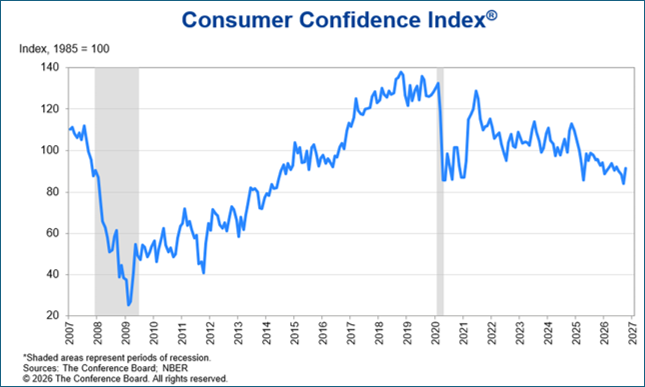
Securities offered through the SouthState | DuncanWilliams 1) are not FDIC insured, 2) not guaranteed by any bank, and 3) may lose value including a possible loss of principal invested. SouthState | DuncanWilliams does not provide legal or tax advice. Recipients should consult with their own legal or tax professionals prior to making any decision with a legal or tax consequence. The information contained in the summary was obtained from various sources that SouthState | DuncanWilliams believes to be reliable, but we do not guarantee its accuracy or completeness. The information contained in the summary speaks only to the dates shown and is subject to change with notice. This summary is for informational purposes only and is not intended to provide a recommendation with respect to any security. In addition, this summary does not take into account the financial position or investment objectives of any specific investor. This is not an offer to sell or buy any securities product, nor should it be construed as investment advice or investment recommendations.


