
The Case for Rate Hikes may have a Second Catalyst

- A week that started with a light data calendar managed to find enough not to like and that led to the highest Treasury yields this year and the highest going back 20 years. The hopes for renewed peace negotiations with Iran did not materialize but have shifted to trying to reopen the Strait in some manner, and emerging data for September points to a rebound in economic activity, hiring, and possibly increasing wage gains. That adds to the Fed’s job of trying to wrestle inflation back to 2%. The Fed originally thought they only need to worry about sticky price pressure from ongoing supply shocks, as the labor market and economy were generating little inflationary push on their own. That story got revised this week and now a rebounding job market, wage gains, and economic growth may add to the price pressure puzzle. That has yields pushing to YTD highs, not to mention 20yr highs, and investors are asking where it all ends? Odds for an October rate hike are near 70% and odds for four or more hikes in total have increased as well. That’s quite the turn of events for a week that seemed rather harmless on Monday. Currently, the 10yr is yielding 5.18%, up 2bp, while the 2yr is yielding 4.90%, up 1bp on the day.
- The renewed push higher in yields on Wednesday got its initial impetus from the preliminary S&P Global PMIs for September. The flash/preliminary report found business activity accelerated for a fourth successive month to reach the fastest rate in more than five years. A further surge in service sector activity was accompanied by renewed improvement in manufacturing output. Employment also rose sharply, with jobs added at a pace not seen for over four years. In addition, backlogs continued to rise and supply chain delays intensified, as constrained operating capacity led to higher prices.
- Meanwhile, the now familiar surge in input costs continued, which only adds to the “sticky” inflation thesis. The S&P’s head economist, Chris Williamson said the report in total, “…points to annualized growth of around 5% with a 4% gain now signaled for the third quarter.” The latest Atlanta Fed GDPNow 3rd quarter GDP estimate is a strong 5.1% with a refresh of the estimate due later this morning.
- The PMI-inspired catalyst for higher yields received a boost when the Iranian peace negotiation story led nowhere, and that contributed to higher energy prices that added fuel to the higher yield story. Meanwhile, previously dovish-minded Fed officials signed on for more rate hikes during the day, and that continued yesterday, signaling higher policy rates are coming. If that wasn’t enough, a poorly received 5yr Treasury auction completed the elements necessary to move yields to YTD highs and in most cases yields last seen some 20 or more years ago.
- The bigger piece of those elements, however, was probably the first one mentioned, the spiking PMIs for September. A rebounding labor market and economy, boosted by accelerating wage gains, were not on the Fed’s bingo card of concerns when they started the hiking cycle last week. Fed Chair Warsh commented then that the labor market was “in equilibrium” allowing them to focus on the inflation side of its mandate. Now, they must be concerned with a labor market and economy that may be finding its second wind in the face of a constrained labor force.
- Rebounding job growth and wage gains complicate the Fed’s goal of returning inflation to its 2% target as they now contemplate wage-push demand that wasn’t in the cards just last week. That’s boosting odds for both an increased pace and quantity of expected rate hikes. That increases the importance of the September jobs report due next Friday. We came into the week more focused on the September CPI report due October 14 as the most consequential pre-FOMC report, after all, the Fed was clearly focused on the inflation story. They now must add the September payrolls report as equally or more important at this point. If it shows the same strength in job growth and, more importantly, wage gains that the preliminary PMIs signaled, it will add to rate hiking odds and almost force the Fed’s hand at its October 28 meeting, less than a week before the mid-term elections.
- Meanwhile, the weekly ADP Pulse report that provides a four-week average of private sector job gains, rose for the week ending Sept. 4 to 20 thousand, a third straight week of increasing job gains (see graph below). The weekly gains point to another solid month of private sector job growth and fits in with the preliminary PMIs and other high-frequency real-time data points. The monthly report is due next Wednesday with expectations for 58 thousand new jobs in September vs. 38 thousand in August.
- The preliminary Durable Goods Orders for August were released this morning and an expected uptick in ex-transportation orders missed the robust forecast. Those orders were up 0.3% vs. 0.6% expected and trailing the 0.7% gain in the prior month (revised up from 0.4%). However, capital goods orders ex-air and transportation, a proxy for business spending, were up a solid 1.6% vs. 0.5% expected and 0.6% in July (revised up from unchanged). These numbers, reflect some of the AI-inspired demand in the business spending category and somewhat agree with the strength in the recent manufacturing PMIs.
Odds for Another Hike at the Oct. FOMC Meeting – Near 70%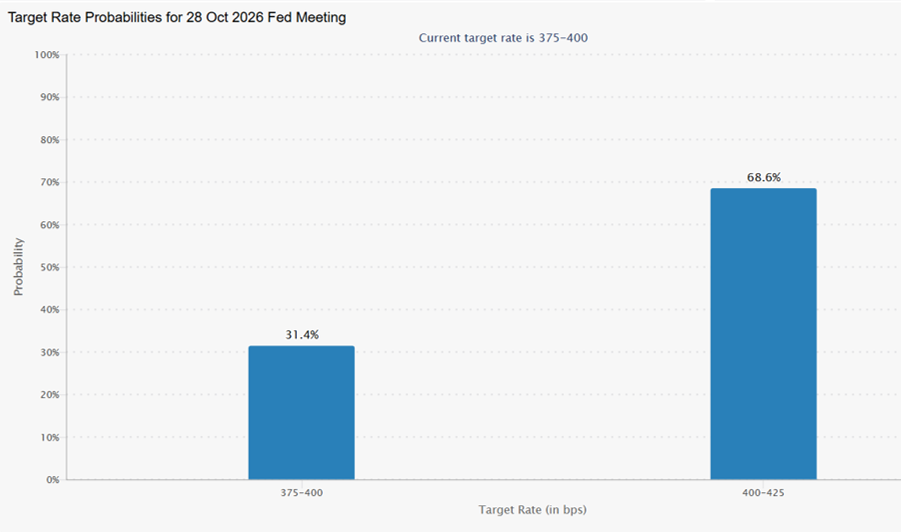 Source: CME Group
S&P Global Flash PMIs for September – Signal an Economy Gaining Strength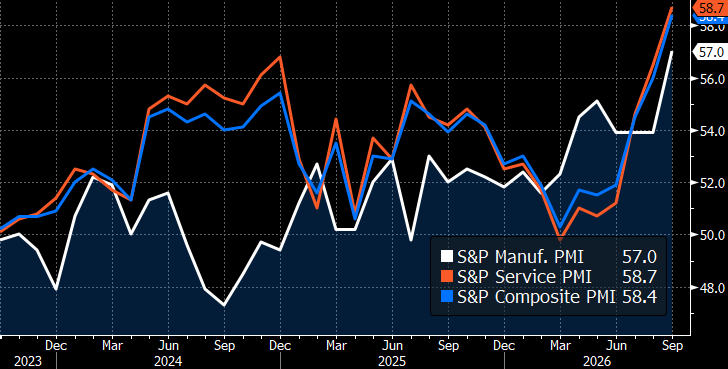 Source: S&P Global
ADP Weekly Pulse Report – Third Straight Week of Increasing Private Payroll Growth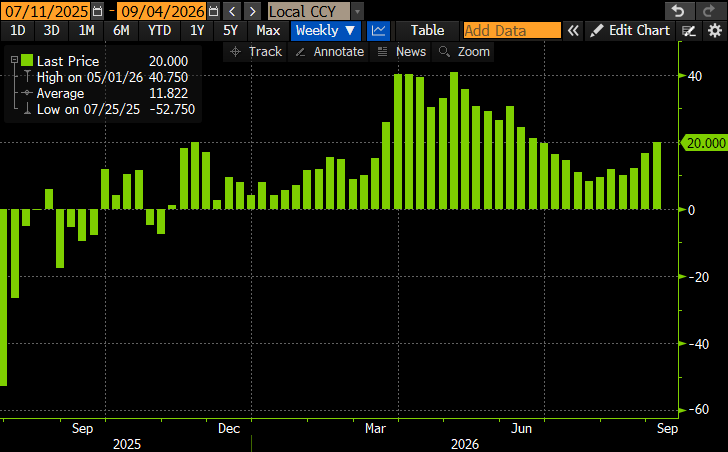 Source: ADP
Strait of Hormuz Vessel Crossings and Oil Prices – High Prices and Low Crossings Continue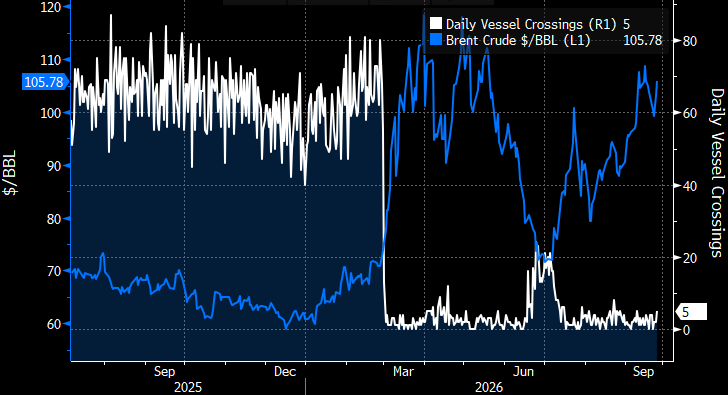
Source: Bloomberg
Securities offered through the SouthState | DuncanWilliams 1) are not FDIC insured, 2) not guaranteed by any bank, and 3) may lose value including a possible loss of principal invested. SouthState | DuncanWilliams does not provide legal or tax advice. Recipients should consult with their own legal or tax professionals prior to making any decision with a legal or tax consequence. The information contained in the summary was obtained from various sources that SouthState | DuncanWilliams believes to be reliable, but we do not guarantee its accuracy or completeness. The information contained in the summary speaks only to the dates shown and is subject to change with notice. This summary is for informational purposes only and is not intended to provide a recommendation with respect to any security. In addition, this summary does not take into account the financial position or investment objectives of any specific investor. This is not an offer to sell or buy any securities product, nor should it be construed as investment advice or investment recommendations.


