
Yields Rise as Geo-Political Concerns Spread

- The story this week has been the upward move in interest rates, with most tenors setting yearly highs, and it’s not just a domestic story, as global yields are moving in the same direction (see graph below). There’s a grab bag of reasons for the move and we’ll dive into some of them below. In addition to purely economic reasons, and the evergreen fiscal deficit excuse, the upward yield moves have another catalyst in the geo-political realm with the widening of the Middle East conflict. We discussed on Wednesday the Iranian-backed Houthi militia threatening to attack Saudi oil tankers sailing through the Bab al-Mandab Strait in the Red Sea. They made good on that threat yesterday by hitting two tankers. The U.S. response has been to blame Iran for the Houthi attacks, and that has contributed to another upward move in oil and set the tone for defensive trading. Currently, the 10yr is yielding 4.68% down 2bps, while the 2yr is yielding 4.33%, down 3bps on the day.
- Oil prices have moved higher this week as we’ve added the additional bottleneck in the Bab al-Mandab Strait in the Red Sea. The widening conflict is contributing both to higher yields as global oil supply is constrained further and diminished hopes for a near-term resolution to the conflict. Prices this morning for WTI are at $89.80/bbl but reached $93.33 yesterday. For the week, prices are up approximately $10/bbl. Brent crude, which is more sensitive to Middle East supply constraints, moved over $100/bbl yesterday and is up $15/bbl for the week.
- While the oil benchmarks are below the worst levels touched in March and April, the rebound from the May and June swoon is not lost on fixed income traders, and the inflationary implications are certainly not lost on the Fed. To that end, odds for a rate hike at next week’s FOMC meeting are at 36%, which is up from less than 20% when the week started. If this were the Powell-led Fed, investors would have a better sense of whether the Fed may act, but Warsh has purposely limited forward guidance and some have opined that he may be more willing to surprise markets; thus, odds have been inching up for a rate hike, but we still believe a rate hike will occur in September.
- As we mentioned above, the higher rate story is not just a domestic one, it’s global as sovereign debt yields have all been on an upward move. Part of that move is the global oil supply story and the inflationary implications of a more long-lived conflict and thus shortages. That catalyst has certainly had a solid week, and it doesn’t look to relent anytime soon.
- Another catalyst is perhaps a bit more academic in nature. The AI story is a well-known source of demand near-term and the potential to enhance productivity is a long-term story. That enhanced productivity is thought will increase potential economic growth and it’s that increased growth potential that has some arguing that the Neutral Rate of Interest – the nebulous equilibrium rate that is neither stimulative nor restrictive – has moved higher.
- The latest Fed Dot Plot has their long-term rate estimate at 3.06%, but analysts now argue the neutral rate is likely closer to 3.25% – 3.50%. That nearly 50bps upward move is also contributing to higher rates along the curve. A key point to consider here is that the increased growth potential, and hence the impact on the Neutral Rate, are not likely to move lower anytime soon. Thus, the upward rate may prove more durable than one purely resting on short-term inflationary factors.
- In addition to the FOMC meeting, next week brings a resumption in first-tier economic releases, headlined by next Thursday’s June PCE inflation numbers, along with income and spending figures. The report’s impact will be considered a bit stale by the events of this week, and any cooler inflation print will be discounted given the counter moves in July. Also, one must put on their radar the equity market reaction to the rates and geo-political story. We’ve stated that the upper-tier consumer, heretofore resiliently consuming, could pull back if an equity correction deepens. We’re not there yet, but one gets the sense that investors, with plenty of profits to protect, may act quickly if equities continue to struggle given the more durable-looking higher-rate environment.
Higher Yields are a Global Story 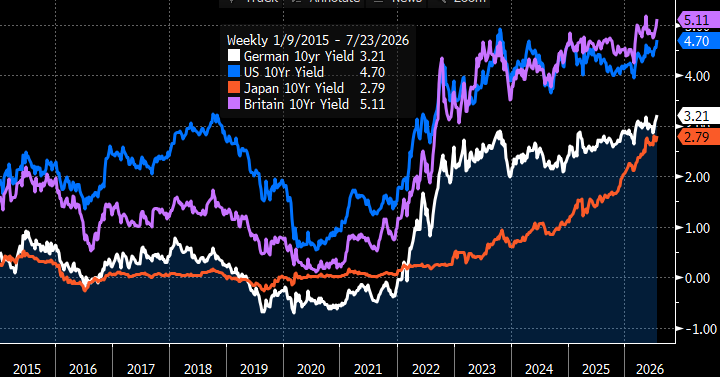 Source: Bloomberg
Oil, Gas, and Diesel Prices Heading Higher Once Again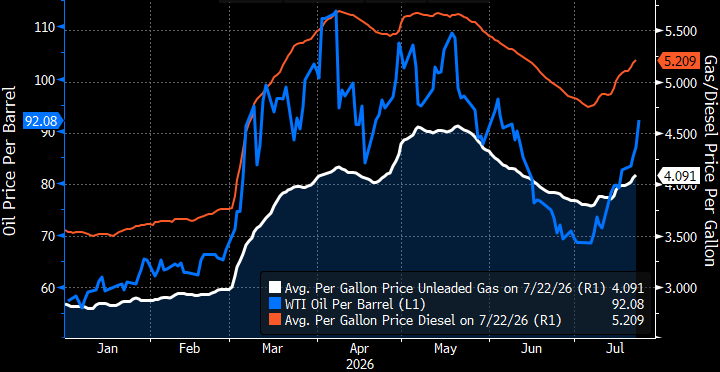 Source: Bloomberg
Neutral Rate Estimate – Moving Higher and Contributing to Higher Yields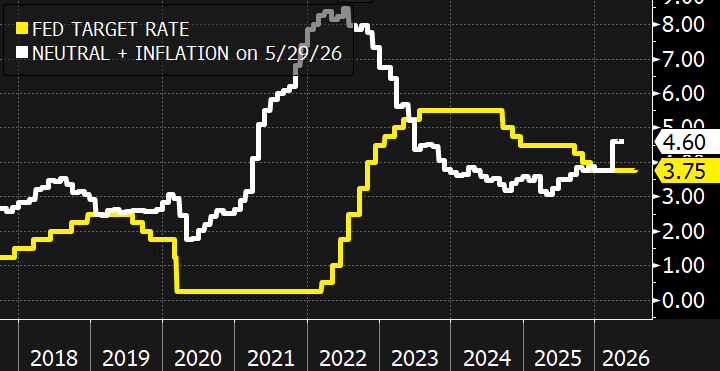 Source: Bloomberg
Securities offered through the SouthState | DuncanWilliams 1) are not FDIC insured, 2) not guaranteed by any bank, and 3) may lose value including a possible loss of principal invested. SouthState | DuncanWilliams does not provide legal or tax advice. Recipients should consult with their own legal or tax professionals prior to making any decision with a legal or tax consequence. The information contained in the summary was obtained from various sources that SouthState | DuncanWilliams believes to be reliable, but we do not guarantee its accuracy or completeness. The information contained in the summary speaks only to the dates shown and is subject to change with notice. This summary is for informational purposes only and is not intended to provide a recommendation with respect to any security. In addition, this summary does not take into account the financial position or investment objectives of any specific investor. This is not an offer to sell or buy any securities product, nor should it be construed as investment advice or investment recommendations.


